Baby Age Calculator: Age in Days, Weeks and Months
Your baby's exact age from the birth date, the next milestone days, and what is typical for sleep and teeth at that age.
The tool
Want this in your pocket? Get the iOS app:


Baby age in weeks and months, and which age to use
Quick conversions for the questions the calculator gets most. They use WHO's average month of 30.4375 days; a real calendar month is 28 to 31 days, so the calculator's answer from a birth date can differ by a few days.
| Weeks | Months |
|---|---|
| 1 | 0.2 |
| 2 | 0.5 |
| 3 | 0.7 |
| 4 | 0.9 |
| 6 | 1.4 |
| 8 | 1.8 |
| 10 | 2.3 |
| 12 | 2.8 |
| 13 | 3 |
| 16 | 3.7 |
| 20 | 4.6 |
| 24 | 5.5 |
| 26 | 6 |
| 30 | 6.9 |
| 32 | 7.4 |
| 36 | 8.3 |
| 40 | 9.2 |
| 44 | 10.1 |
| 48 | 11 |
| 52 | 12 |
| Months | Weeks |
|---|---|
| 1 | 4.3 |
| 2 | 8.7 |
| 3 | 13 |
| 4 | 17.4 |
| 5 | 21.7 |
| 6 | 26.1 |
| 7 | 30.4 |
| 8 | 34.8 |
| 9 | 39.1 |
| 10 | 43.5 |
| 11 | 47.8 |
| 12 | 52.2 |
| 13 | 56.5 |
| 14 | 60.9 |
| 15 | 65.2 |
| 16 | 69.6 |
| 17 | 73.9 |
| 18 | 78.3 |
| 19 | 82.6 |
| 20 | 87 |
| 21 | 91.3 |
| 22 | 95.7 |
| 23 | 100 |
| 24 | 104.4 |
Which age is used for what
| What | Age used | Why |
|---|---|---|
| Vaccinations | Age from birth | Schedules run on calendar age, for babies born early too. |
| Growth percentiles (WHO) | Age in days; corrected for babies born before 37 weeks | WHO's tables go day by day, so a 3-week-old is not scored as a newborn. |
| Milestones | Corrected age until 24 months if born before 37 weeks | A baby born early is compared with babies who had the same time to develop. |
| Sleep and wake windows | Age from birth | The age bands are counted from birth; ask your paediatrician about a baby born early. |
| Teething | Age from birth | Eruption charts are averages from birth, with a wide normal spread. |
CDC milestone checklists
CDC publishes free milestone checklists at 2 months, 4 months, 6 months, 9 months, 12 months, 15 months, 18 months, 24 months, 30 months and 36 months — the things most children (about 75% or more) do by each age. The calculator shows the next one and its date.
Talk to your paediatrician if…
- your baby loses a skill they used to have;
- your baby is not doing one or more things on the checklist for their age, or you have any worry about how they are developing — CDC's advice is not to wait;
- your baby was born early and you are not sure which age to use for milestones or growth;
- your baby is under 3 months and has a temperature of 38 °C or higher (call straight away).
Call your emergency number if your baby has trouble breathing, turns blue or grey, cannot be woken, or has a fit.
How this works
Enter your baby's date of birth. The calculator shows the age in the form people actually say it — days for the first two weeks, weeks and days up to eight weeks, then months and days — together with the total in days, in weeks and days, and in calendar months and days. Change the second date to see the age on a check-up, a photo day or a birthday.
Below the age it lists what is coming up: 1 month, 100 days, the half birthday, the first birthday, 500 days, 18 months, 1,000 days and the second birthday, each with its date and how many days away it is. It also gives the date of the next CDC milestone checklist age, so you know when to look at what most babies do by then.
For babies under two it adds a snapshot of the age: the wake window and nap count from the ProbaBaby app's sleep bands, and how many teeth are typical by the ADA eruption chart. If your baby was born before 37 weeks, milestones and growth are read by corrected age instead; the corrected age calculator works that out.
Nothing you enter is uploaded. The dates live in the page address, so you can bookmark the result or send it to a partner, and it updates every day you open it.
The math behind it
Days old = the number of calendar days from the birth date to the chosen date; the day of birth is day 0. Weeks = days ÷ 7, rounded down, with the leftover days shown beside them.
Months are calendar months, not 30-day blocks. A month is complete on the same day of the next month, or on that month's last day when it is shorter: a baby born on 31 January is 1 month old on 28 February (29 in a leap year), and a baby born on 29 February turns 12 months on 28 February the next year. The leftover days are counted from that point.
Worked example. Born 14 March 2026, on 11 October 2026: 211 days old, 30 weeks and 1 day, and 6 months and 27 days — 6 months were completed on 14 September, and 27 days have passed since. Milestone days are the same arithmetic forwards: 100 days old on 22 June 2026, the first birthday on 14 March 2027, 1,000 days old on 8 December 2028.
This is the ProbaBaby app's own age engine, checked against the app's output for named cases and for 471 birth-date and day pairs around leap-year Februaries and month ends. The sleep snapshot uses the app's nine sleep bands and the teeth line the app's tooth chart, both read at the age in days.
In the ProbaBaby app
iPhone · iPad · Apple WatchYour baby's age, kept up to date wherever you track
Add your baby once with the birth date. The app keeps the age current and reads milestones and growth against the right one.
The app also
- For babies born before 37 weeks, the app shows the corrected age next to the real one until 24 months.
- 58 milestones based on CDC and AAP guidance, with the date, a photo and notes when your baby reaches each one.
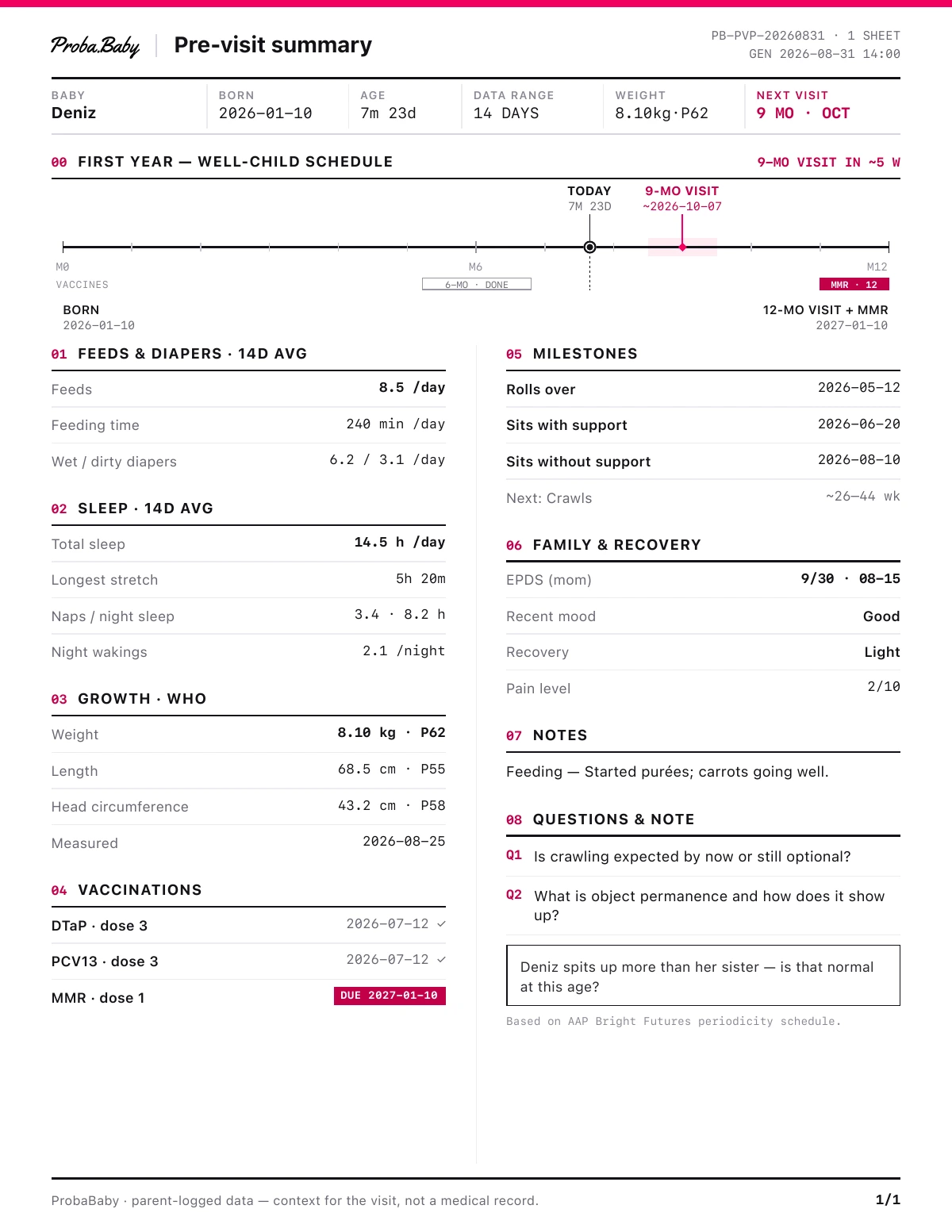
- WHO growth charts for weight, length and head circumference, and a Pediatrician Prep PDF for checkups.
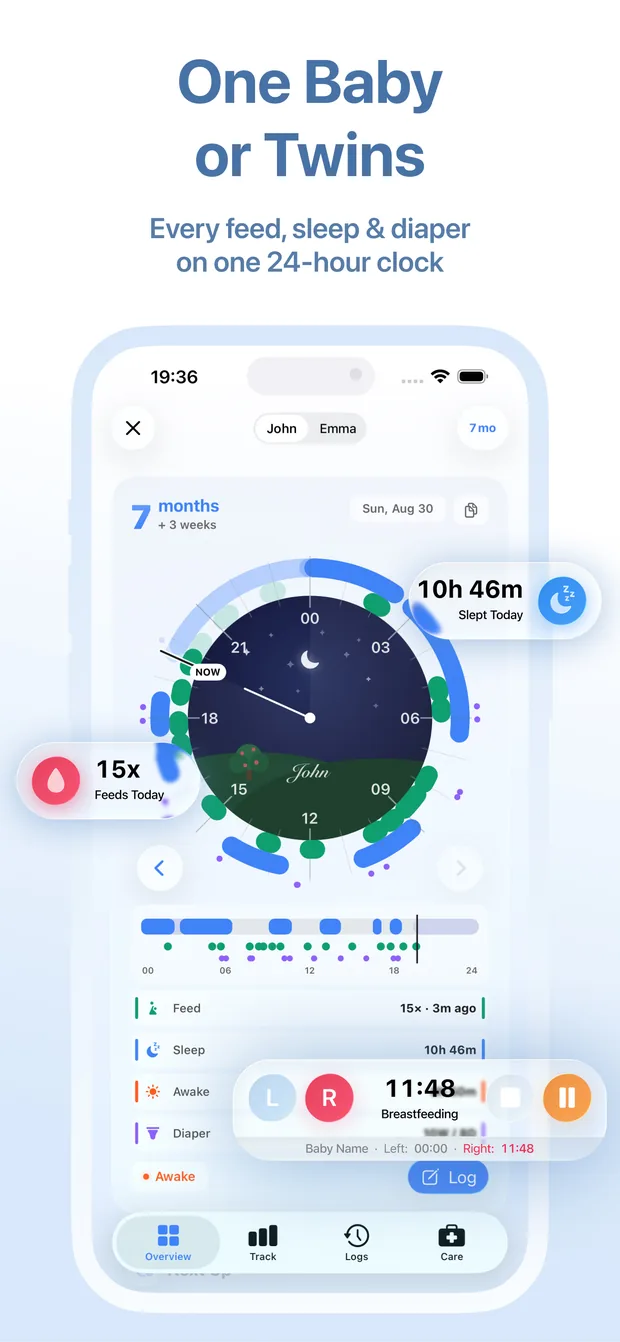
- Unlimited babies for free, and each twin gets their own Home card, Lock Screen widget and Apple Watch page.
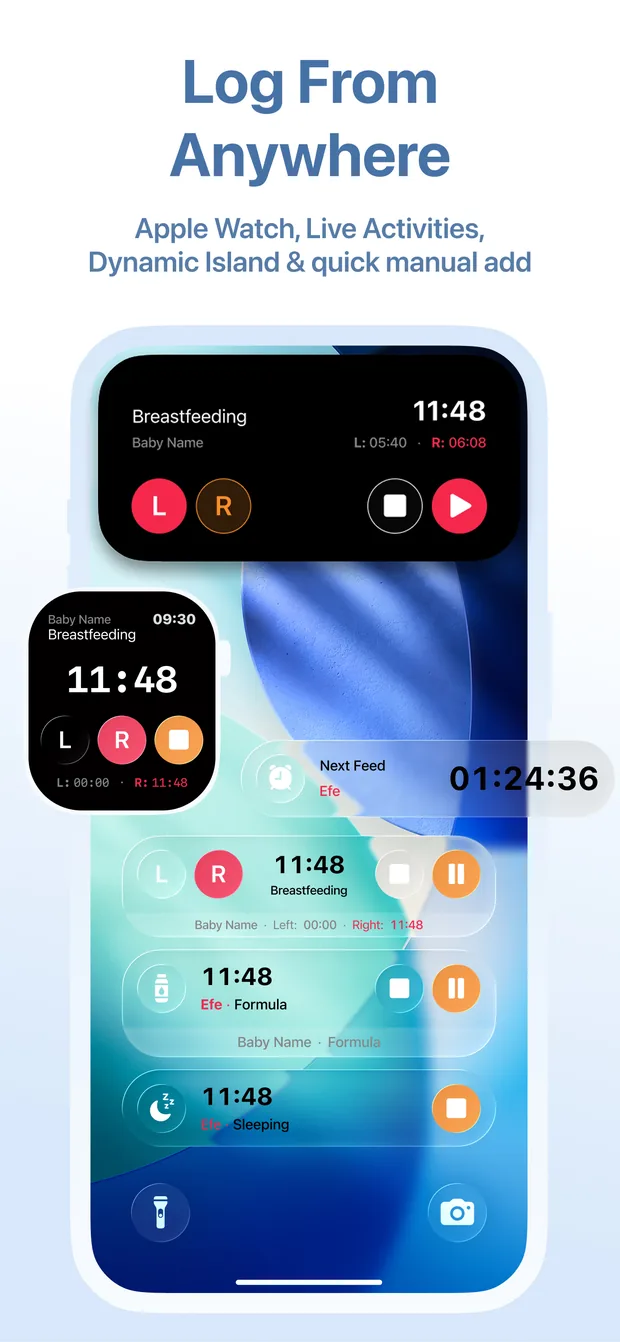
Baby: feeding (breast, bottle, pumped milk, formula and solids), sleep with pattern insights, diapers with stool colour, WHO growth percentiles, 58 milestones, a 24-hour day clock, a red-light night console, age-adaptive feeding reminders and an alarm that wakes you even on silent.
On the App Store
Sheet 1 of 1
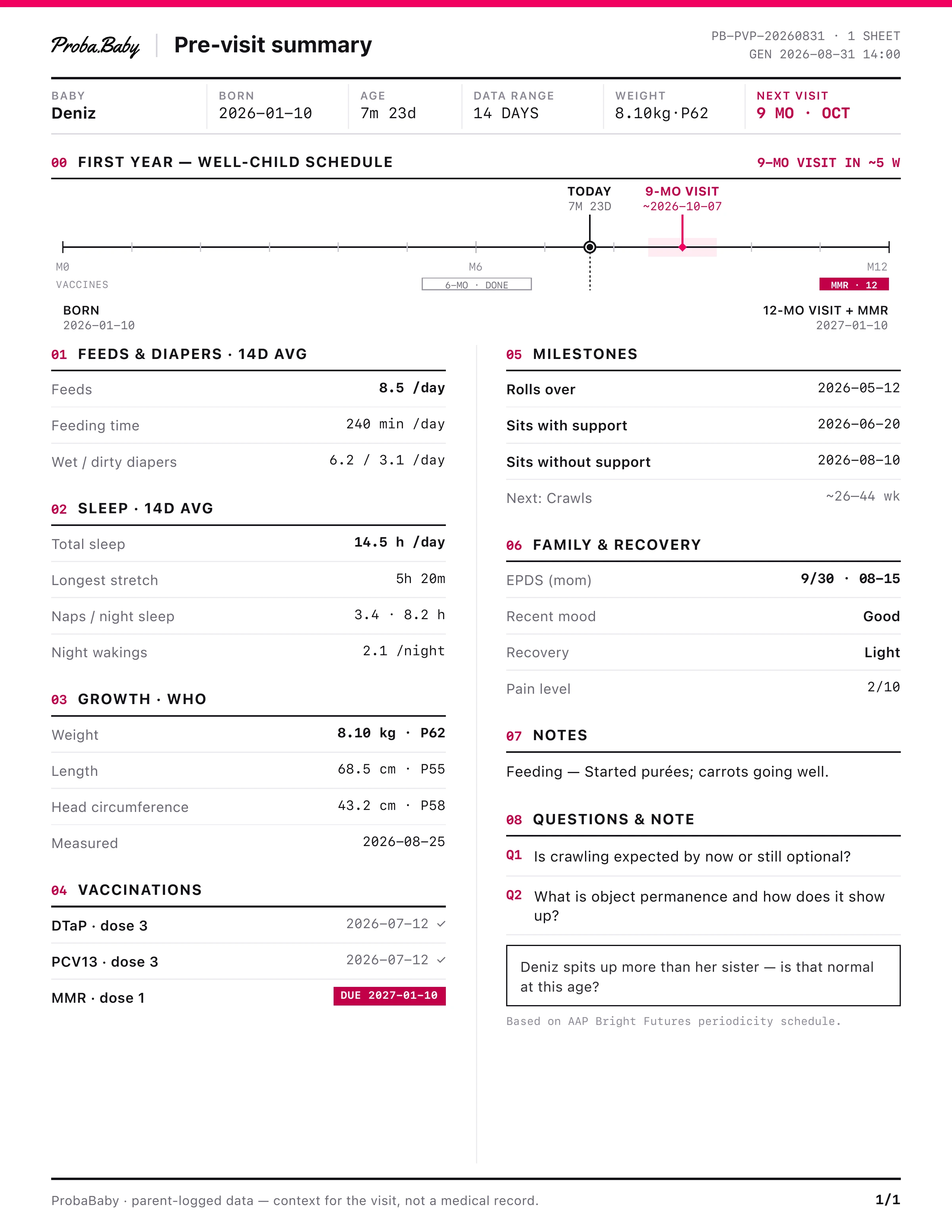
Sample pre-visit summary for the pediatrician: first-year well-child timeline, feeds, sleep, WHO growth percentiles, vaccines, milestones and your questions on one sheet. Fictional baby.
Frequently asked questions
Count whole calendar months from the birth date: a month is complete on the same date of the next month. Born on 14 March, your baby is 6 months old on 14 September, and on 11 October is 6 months and 27 days. When the next month is shorter, the month completes on its last day — born on 31 January, a baby is 1 month old on 28 February.
About 13 weeks. Three average months are 91.3 days, which is 13.0 weeks; by the calendar it is 89 to 92 days depending on which months they are. The tables below convert every week up to 52 and every month up to 24.
Because there are two conventions. Some count weeks and convert with an average month of 30.4 days; others count calendar months from the birth date, as this calculator does. The two can be a few days apart. For a baby born early, clinicians may also use the corrected age for milestones and growth.
For milestones and growth charts, yes, until 24 months if your baby was born before 37 weeks — that is how paediatricians track a baby born early, and it is not a sign of delay. Vaccinations are the exception: they follow the age from birth. Our corrected age calculator works out both.
On the birth date plus 100 days, counting the day of birth as day 0. Born on 14 March 2026, a baby is 100 days old on 22 June 2026. The calculator lists the date, and the 500 and 1,000 day marks, under the age.
2, 4, 6, 9, 12, 15, 18, 24, 30 and 36 months, among others up to 5 years. Each checklist lists what about 75% or more of children do by that age, a level the CDC chose so that even one missing item is worth acting on: if your baby is not doing one or more of them, or has lost a skill, talk to your paediatrician rather than wait and see.
No. The calculator works in whole calendar days, using the date on your device, so the age only changes at midnight where you are. If your baby was born in another time zone, enter the birth date on the birth certificate.
Related tools
Related tools