Mayan Gender Predictor
An ancient parity method: your age and the conception month decide boy or girl — instantly, and just for fun.
The tool
Want this in your pocket? Get the iOS app:


How this works
The Mayan gender predictor is a traditional method attributed to ancient Mayan numerology. It looks at exactly two numbers: the mother's age at conception and the month of conception. Instead of charts or calendars, it asks one simple question — are those two numbers both even, both odd, or mixed?
To use it, pick the mother's birth date and the date you conceived (or plan to conceive). The prediction updates instantly: if the age and the month are both even or both odd, the method says girl. If one is even and the other is odd, it says boy.
This tool is a 1:1 port of the Mayan predictor inside the ProbaBaby iOS app. Like the app, it takes a full conception date: your age is counted in whole years to the day you actually conceived — no month-midpoint stand-in and no assumed year, so the answer doesn't flip just because you picked a month on the other side of your birthday.
This is for entertainment only and has no scientific basis. Because there are only two possible answers, a rule like this lands on the right one about as often as a coin flip — enjoy it as a fun tradition, not a diagnosis.
The math behind it
The engine takes the conception date you picked, exactly as you picked it. There is no day-15 anchor and no assumed year — the app replaced its month grid with a real, unbounded date picker, and this port follows it.
It then computes the mother's age as the number of full calendar years between her birth date and that conception date. If the birth date falls after the conception date the inputs are rejected rather than scored — the app does not clamp, so a port has to validate instead.
The prediction is pure parity arithmetic: ageIsEven = age % 2 == 0 and monthIsEven = month % 2 == 0. If ageIsEven equals monthIsEven — both even or both odd — the result is girl ("Both Same"). If they differ — one even, one odd — the result is boy ("Both Different").
Because the age is measured to the real conception date, moving that date across your birthday is the only thing that changes it — there is no hidden current-year assumption pushing the answer around. The old fallback that treated a missing age as 25 is gone from the app, and from here.
There is no lookup table and no biology in this formula — it is a binary rule over two parities. Statistically, that is a coin flip: expect roughly 50% accuracy, which is exactly why this tool is labeled entertainment-only.
In the ProbaBaby app
iPhone · iPad · Apple WatchFolklore for fun in the app, and genetics when you want an answer you can check
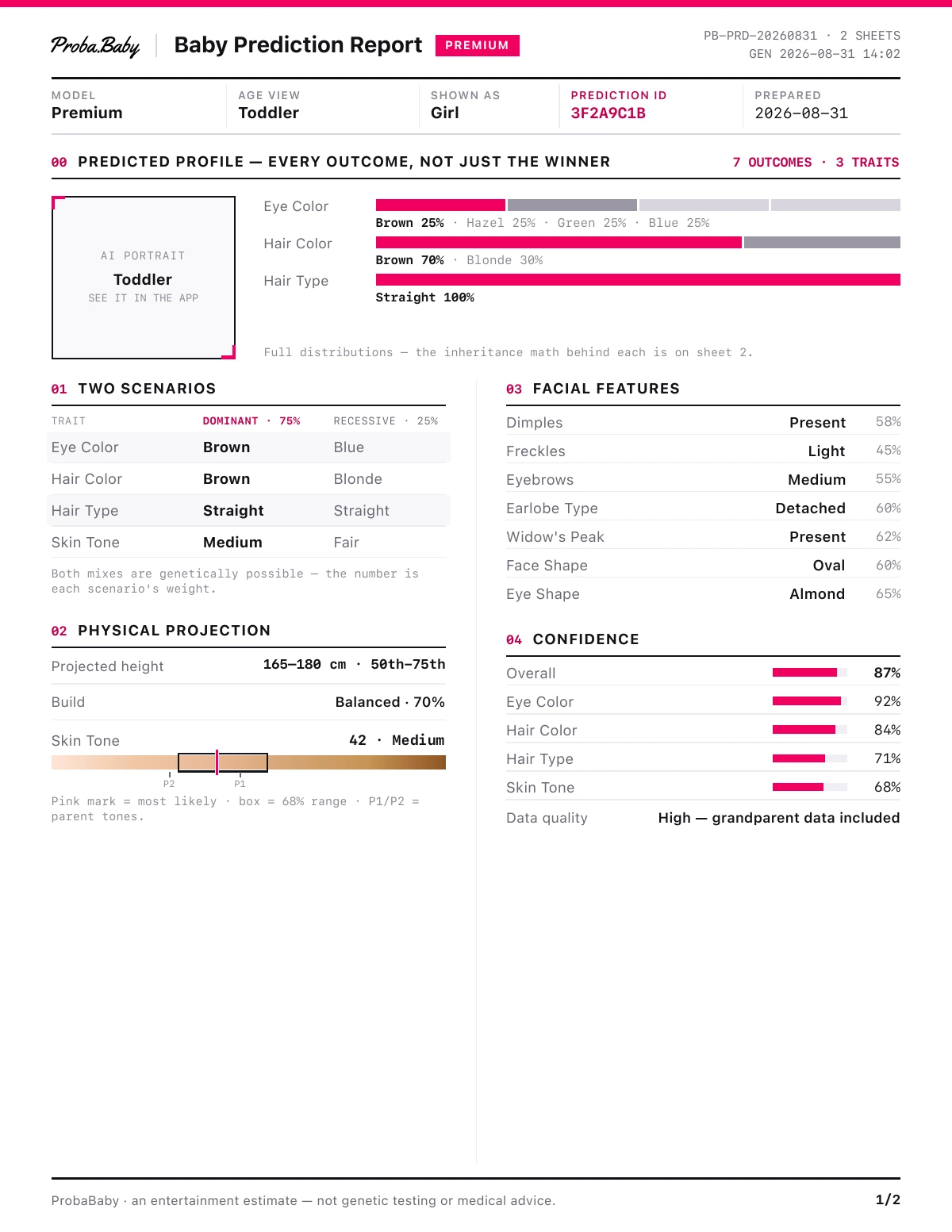
The Mayan method is an odd-or-even rule, so it is right about half the time, like a coin toss; a scan or a prenatal test is what tells you. The ProbaBaby app keeps it as a fun tool and adds a prediction of the traits your baby may inherit, worked out with Punnett squares.
The app also
- The app's Mayan and Chinese tools take two dates and show how they reach the answer before the reveal, both labelled for entertainment.
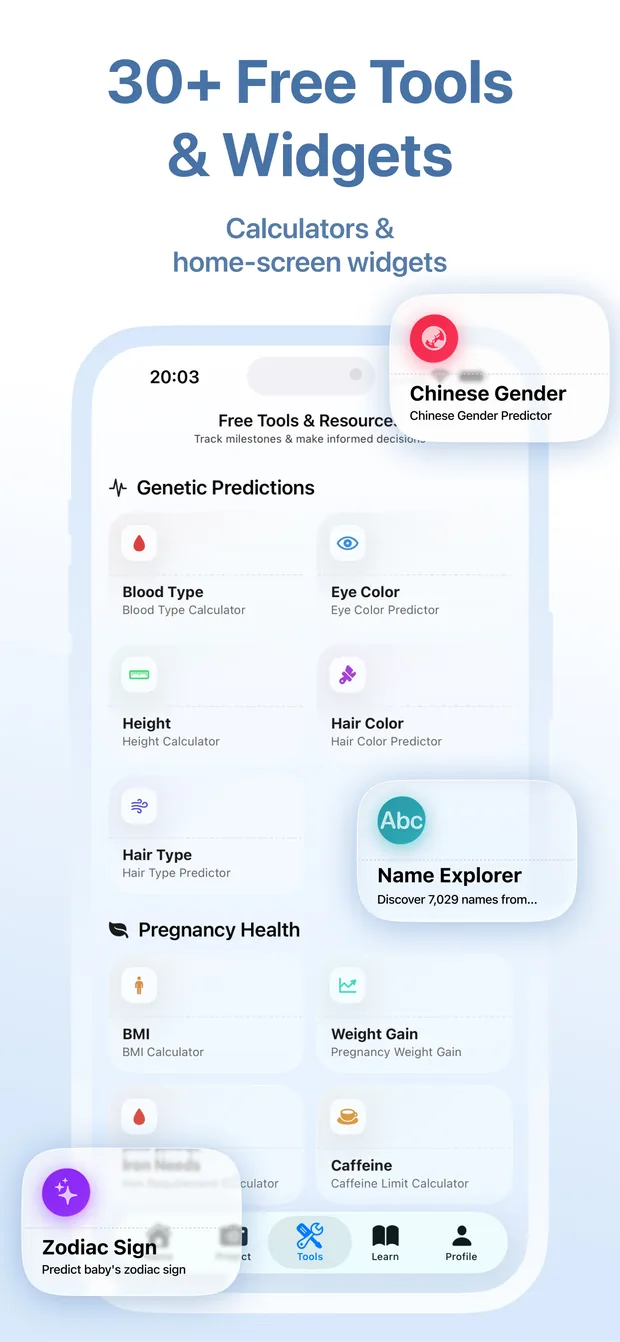
- Ovulation, fertility-window, conception-date and due-date calculators sit in the same group, among 32 free tools in 7 categories.
- The baby prediction works out eye colour, hair colour and type, skin tone, height range and facial features from what you tell it about both parents.
- Scientific mode needs no photos: it works from the traits you describe and gives a written genetics report with a PDF.
Every new account gets 5 starter credits — enough for one free Scientific prediction (4 credits).
On the App Store

Sheet 1 of 2
Frequently asked questions
It compares two parities: the mother's age at conception and the conception month (1–12). If both numbers are even or both are odd, the prediction is girl. If one is even and the other is odd, the prediction is boy. That's the whole rule — no charts, no lookup tables.
The month's even/odd status is half of the rule. The engine reads the month straight off the conception date you picked (January = 1 through December = 12) and asks only whether that number is even or odd.
Yes. The app takes a full conception date and so does this tool — your age is counted to the day you actually conceived, not to the middle of a month in the current year, so nothing flips on an arbitrary anchor.
About as accurate as a coin flip — roughly 50%. It is for entertainment only and has no scientific basis. Treat it as a fun tradition to share, not a way to actually determine your baby's sex.
Nothing is scored. The two dates would produce a negative age, which the parity rule has no meaning for, so the tool asks you to fix the dates instead of showing a prediction. The app's old age-fallback constant of 25 is gone.
Both are legendary traditional methods, but they work differently: the Chinese method converts your dates with the Chinese calendar and reads the answer out of a real 18–45 by 12 chart, while the Mayan method is a single even/odd parity rule on your age and the conception month. Neither has scientific backing — try both and compare for fun.