Chinese Gender Predictor
A boy-or-girl guess read off the real traditional chart — your dates converted with the Chinese calendar, just for fun.
The tool
Want this in your pocket? Get the iOS app:


How this works
Pick the mother's birth date and the date the baby was (or will be) conceived. Both are full dates, because both matter: your nominal age is counted in lunar years from your birth to the moment of conception, so the year you conceived is part of the answer.
Both dates are converted with the Chinese calendar. Your nominal age (虚岁) is the difference between the two lunar years, plus one — the traditional convention where a newborn is already one year old, and where you gain a year at each lunar new year rather than on your birthday. The month is the Chinese-calendar month of the conception date, not the Gregorian one.
That age-and-month pair is then looked up in the chart itself — the 28-row by 12-column table for nominal ages 18 to 45, the one legend says was found in a 700-year-old royal tomb. The whole chart is printed under the result with your cell marked. If your nominal age falls outside 18–45 the chart has no row for you, and the tool says so instead of guessing. The result updates instantly, and the link in your address bar captures your inputs so you can share it.
This is an entertainment tool. The prediction has no scientific basis, and its actual accuracy is around 50% — the same as flipping a coin.
The math behind it
Full transparency: this tool does the real thing. Your dates are converted with the Chinese calendar, your traditional nominal age is scored at the moment of conception, and the answer is read out of the authentic 18–45 lunar-age by 12 lunar-month table — the same chart and the same conversion the ProbaBaby iOS app uses. If your nominal age falls outside 18–45 the chart has no row for you, and the tool says so rather than guessing.
Step 1 — nominal age (虚岁): both dates are resolved on the Chinese calendar and nominalAge = lunarYear(conception) − lunarYear(birth) + 1. It is measured at the conception date, not today, and it advances at each lunar new year rather than on your birthday — so it can differ from your western age by one either way. Step 2 — lunar month: the Chinese-calendar month of the conception date (1–12). An intercalary (leap) month folds into the number of the month it repeats, because the traditional chart has no leap row; the tool flags it when that happens.
Step 3 — the lookup. The answer is the cell at (nominal age, lunar month) in the transcribed chart: 28 rows for ages 18 to 45, 12 columns for the lunar months, each cell either Boy or Girl. There is no formula behind the cells — the chart is reference data, transcribed from two published charts and diffed against each other.
Off-chart returns nothing at all. Nominal ages below 18 or above 45 have no row in the traditional chart, and the tool renders an explicit "off the chart" state instead of extrapolating a cell that does not exist. The app's own backend enforces the same 18–45 constraint.
In the ProbaBaby app
iPhone · iPad · Apple WatchThe same chart in the app, next to a prediction built on genetics
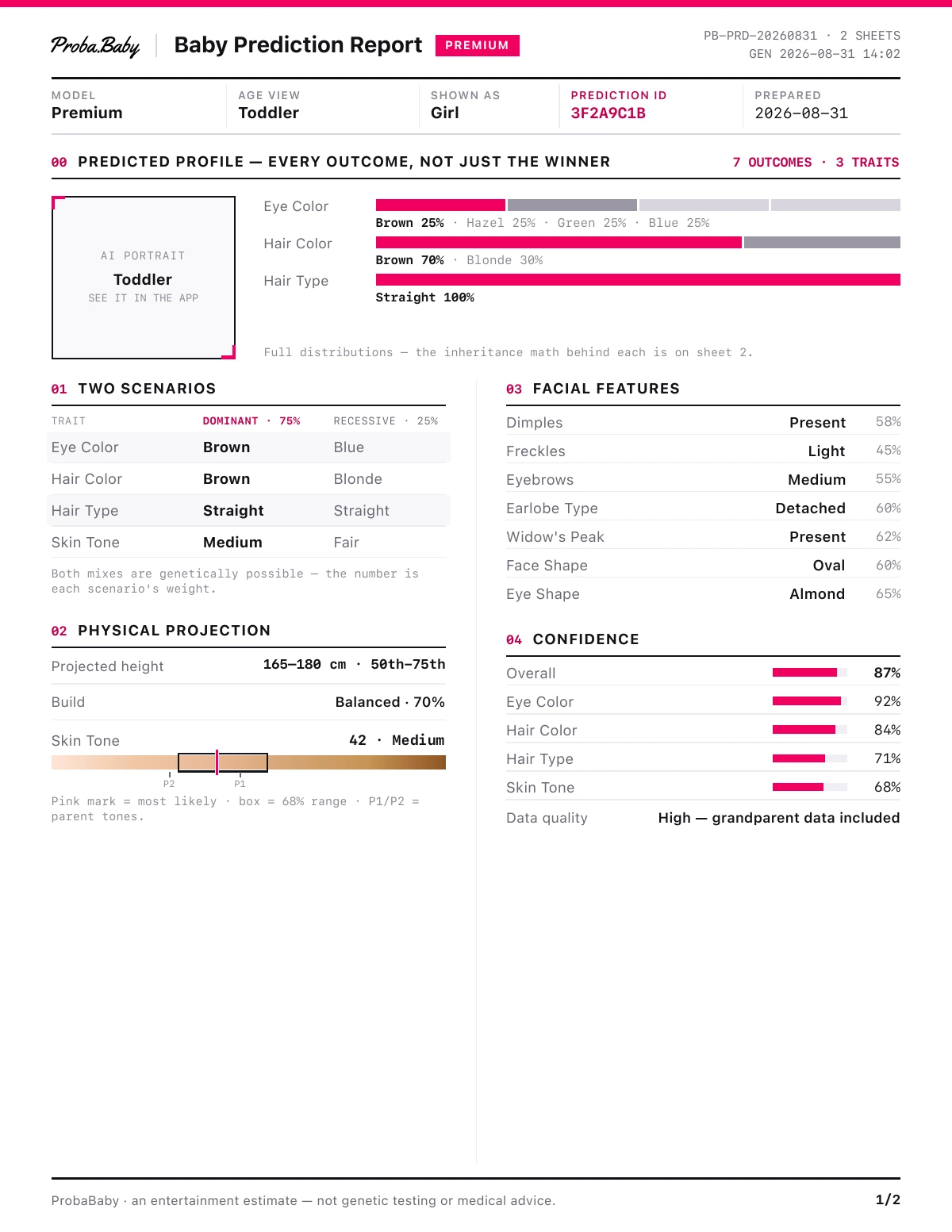
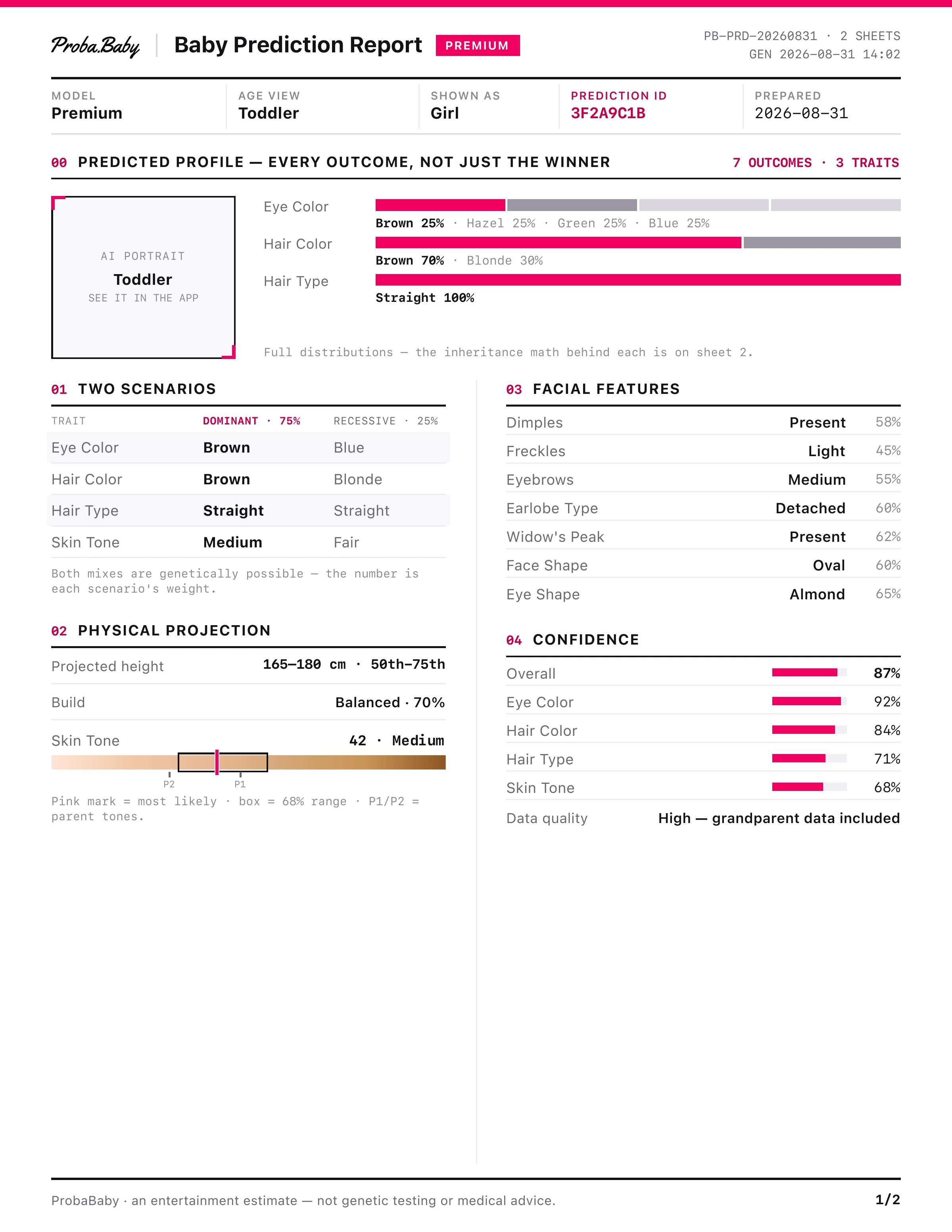
A chart guesses a baby's sex about as well as a coin; a scan or a prenatal test is what tells you. What genetics can work out is traits, and that is what the ProbaBaby app's prediction does, with Punnett squares you can check.
The app also
- The app's Chinese gender tool reads the same lunar chart and shows how it got there before the reveal. Outside the chart's ages it gives no answer rather than a guess.
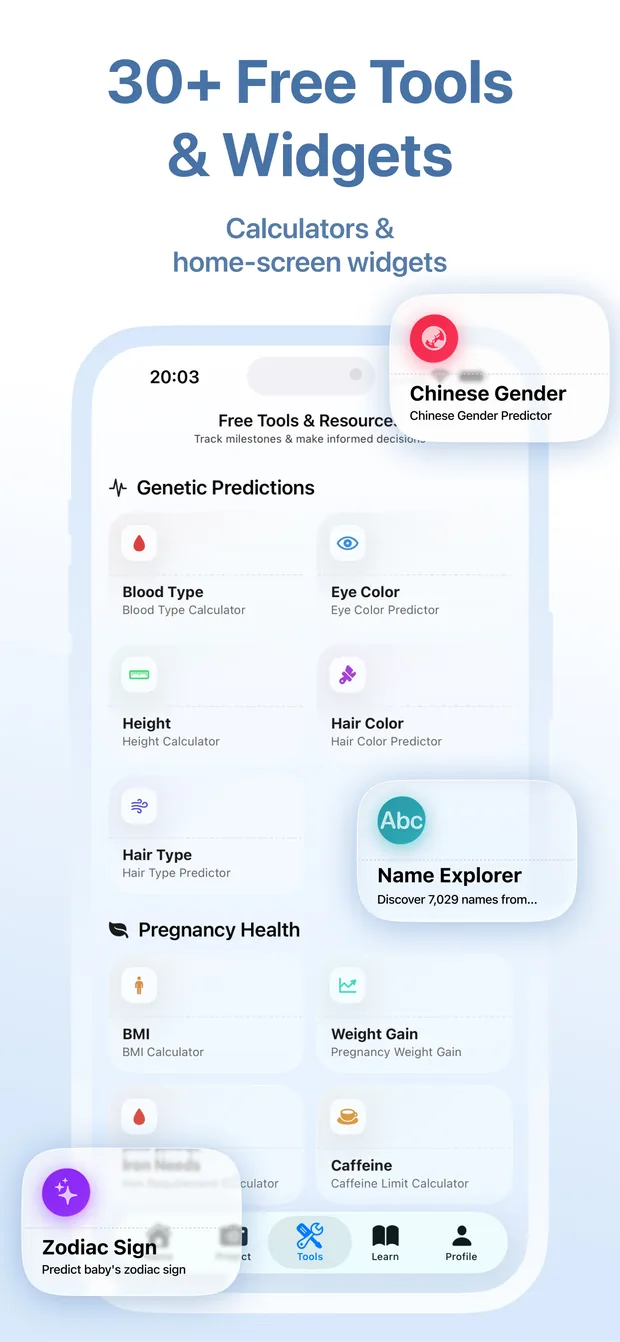
- The Mayan predictor, a zodiac tool, and ovulation, fertility-window and due-date calculators sit beside it, among 32 free tools in 7 categories.
- The baby prediction works out eye colour, hair colour and type, skin tone, height range and facial features from what you tell it about both parents.
- Scientific mode needs no photos: it works from the traits you describe and gives a written genetics report with a PDF.
Every new account gets 5 starter credits — enough for one free Scientific prediction (4 credits).
On the App Store

Sheet 1 of 2
Frequently asked questions
It combines two coordinates, both resolved on the Chinese calendar: the mother's nominal age (虚岁) at the moment of conception, and the Chinese-calendar month of that conception date. Those two numbers point at one cell in the traditional 18–45 by 12 chart, and the cell says Boy or Girl. There is no formula — the chart is reference data.
This tool reads the traditional 18–45 lunar-age by 12 lunar-month table with a real Gregorian-to-Chinese calendar conversion, and so does the ProbaBaby iOS app. Sites still differ, though: transcriptions of the chart disagree in a few cells, some sites use western age plus one instead of the nominal 虚岁 at conception, and many skip the calendar conversion entirely and pass your Gregorian month straight through.
About 50% — the same as random chance or flipping a coin. Since a baby is either a boy or a girl, any method "works" roughly half the time. It has no scientific basis and is for entertainment only; it should never be used for medical decisions.
Yes. Your nominal age is counted in lunar years from your birth to the moment of conception, so the year you conceived is part of the answer — which is why the tool asks for a conception date, not just a month.
It is the traditional Chinese 虚岁: you are one year old at birth, and you gain a year at each lunar new year rather than on your birthday. The tool measures it at the conception date by resolving both dates on the Chinese calendar, so it can sit one year either side of your western age depending on where your birthday falls relative to the lunar new year.