Pregnancy Weight Gain Calculator
See your IOM-recommended weight gain range by pre-pregnancy BMI, week by week — for singleton and twin pregnancies.
The tool
Want this in your pocket? Get the iOS app:


How this works
Set your pre-pregnancy weight (kg or lbs), your height, your current pregnancy week, and whether you're expecting one baby or twins. The calculator first works out your pre-pregnancy BMI — that single number decides which recommendation band applies to you.
From your BMI, the calculator looks up the Institute of Medicine (IOM) 2009 guideline range: a total recommended gain for the whole pregnancy and, for singletons, a published weekly gain rate for the second and third trimesters. Toggle to twins and the same BMI thresholds map to the higher twin totals — but the IOM publishes no twin weekly rate at all, and it has no twin row for an underweight BMI. The tool derives the one and refuses to invent the other.
Your current week turns those ranges into a concrete target: how many kilograms (or pounds) you'd typically have gained by now. First-trimester gain is small, and it is a band rather than a point — 1.2–1.8 kg for one baby and 1.8–2.7 kg for twins across the first 12 weeks — with the steady weekly gain only starting after week 12. Each end of the running target is clamped to that band's own total, so it can never ask you to have gained more than the whole-pregnancy recommendation.
Everything updates live as you move the sliders, and your inputs are stored in the page URL so you can share or bookmark your result. All math runs in kilograms; pounds are converted exactly at the boundaries.
The math behind it
Step 1 is your pre-pregnancy BMI: BMI = weight (kg) ÷ height (m)². For example, 65 kg at 165 cm gives 65 ÷ 1.65² = 23.9. If you enter pounds, they're converted with the exact factor 1 lb = 0.45359237 kg before any math happens.
Step 2 looks up the IOM 2009 band. For a single baby: BMI under 18.5 → 12.5–18.0 kg total, 0.44–0.58 kg/week; BMI 18.5 to under 25 → 11.5–16.0 kg total, 0.35–0.50 kg/week; BMI 25 to under 30 → 7.0–11.5 kg total, 0.23–0.33 kg/week; BMI 30 and above → 5.0–9.0 kg total, 0.17–0.27 kg/week.
For twins the IOM publishes totals only, and no weekly rate at all: BMI 18.5 to under 25 → 16.8–24.5 kg, BMI 25 to under 30 → 14.1–22.7 kg, BMI 30 and above → 11.3–19.1 kg. Where this tool shows a twin weekly figure it is derived, not published — ProbaBaby's Tools weight-gain calculator spreads the published total from its first-trimester band across the 25 weeks to a 37-week term, giving 0.60–0.87, 0.49–0.80 and 0.38–0.66 kg/week respectively — and the tool labels it as derived on screen. If you are underweight (BMI under 18.5) and carrying twins, no range is shown at all: the IOM's 2009 table has no row for you, and inventing one would be worse than saying so.
Step 3 is the current-week target. The first trimester is a band, not a point: 1.2–1.8 kg for one baby and 1.8–2.7 kg for twins across the first 12 weeks (these are the ProbaBaby Tools calculator's figures — the pregnancy module's Track tab uses a wider 1.8–3.6 kg twin ramp, so never quote one without naming the surface). Through week 12: target = that band × (week ÷ 12). After week 12: target = the band + (week − 12) × the weekly rate, with each end clamped to that band's own total — so the running target can never exceed the whole-pregnancy recommendation printed above it.
The engine never rounds internally — only the displayed values are formatted. Results shown in pounds are converted from kilograms at 1 kg = 2.20462 lbs for display only. The week progress bar counts against the term for your pregnancy — 40 weeks for one baby, 37 for twins — so "weeks to go" is max(0, term − week). Counting a twin pregnancy against 40 would overstate the time left.
In the ProbaBaby app
iPhone · iPad · Apple WatchLog your weight and see it against your range, every week
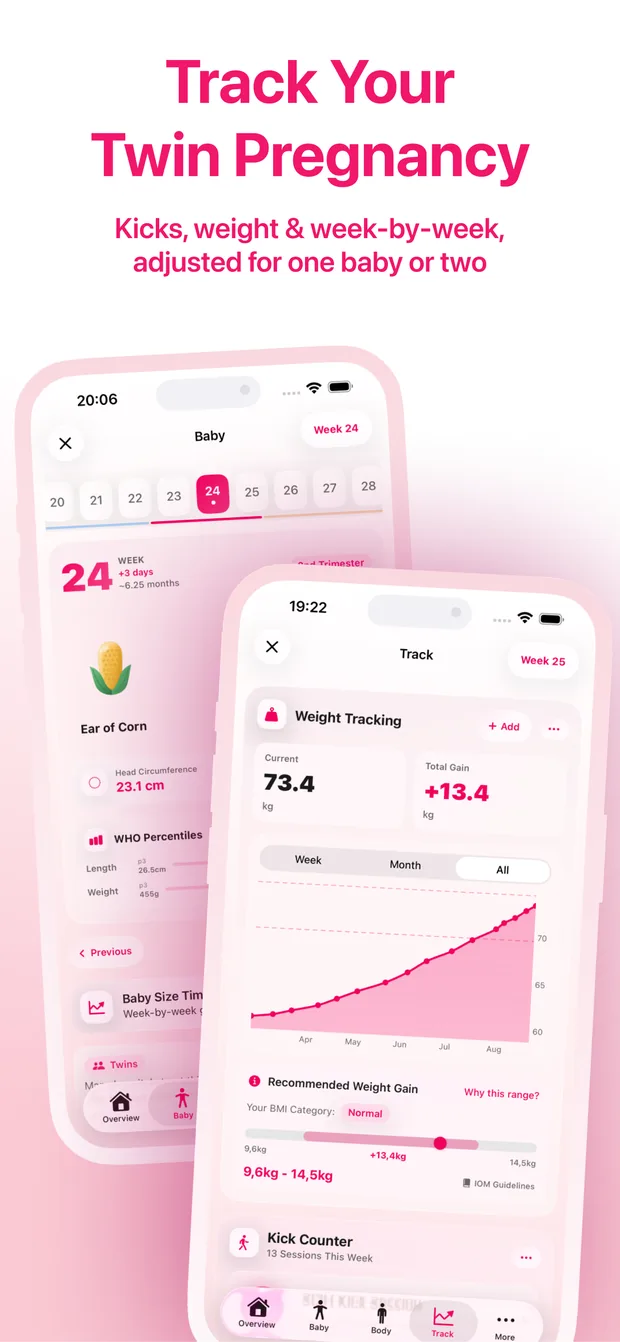
This page shows the range. The app tracks you inside it: log a weight in a tap and the chart shows where you are for your week.
The app also
- Log your weight from the Today screen and see it charted against the IOM 2009 range for your pre-pregnancy BMI.
- Twin pregnancies use the IOM 2009 provisional twin ranges; where the guidance gives no range, the app says so instead of inventing one.
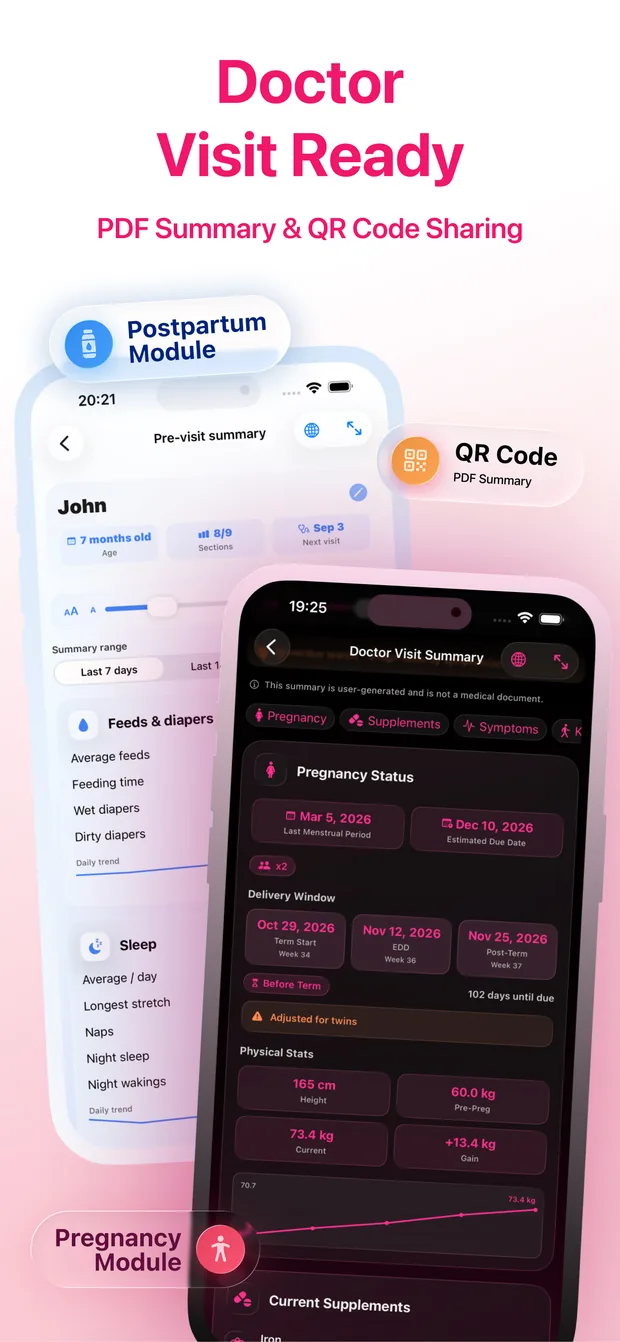
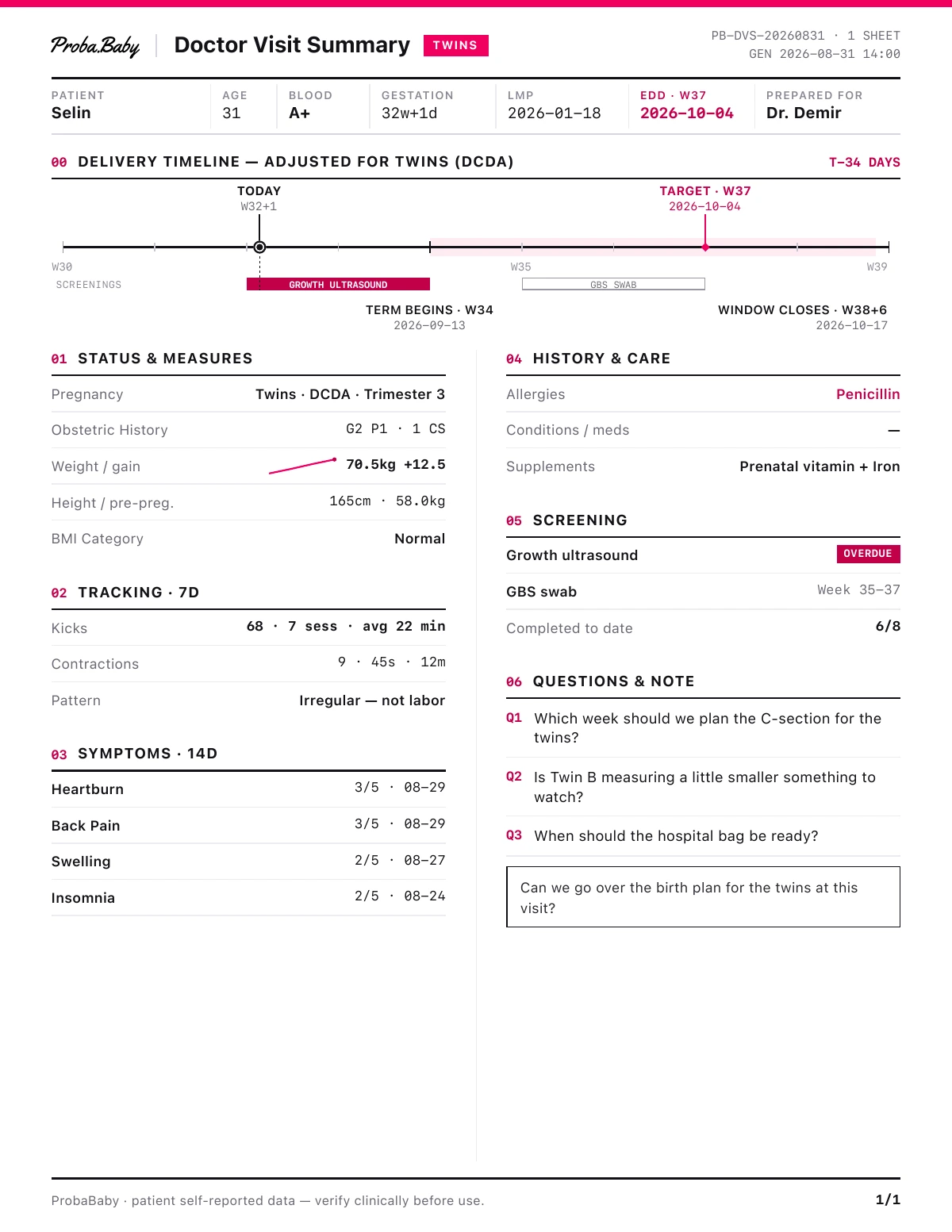
- Your weight trend is on the one-page Doctor Visit Summary PDF you take to appointments.
- Week-by-week content for weeks 1 to 42, 51 medical tests and a symptom log in the same module.
Free to download and use: pregnancy, baby and mom tracking, 32 tools, PDF reports, widgets, Apple Watch and family sharing cost nothing. Only AI baby predictions use credits.
On the App Store
This page and the app, side by side
| Feature | This page | ProbaBaby app |
|---|---|---|
| Your range | IOM 2009 by pre-pregnancy BMI, singleton or twins | The same ranges |
| Your weight | One check at a time | Logged over the whole pregnancy and charted |
| For your doctor | — | Weight trend on the Doctor Visit Summary PDF |
Sheet 1 of 1
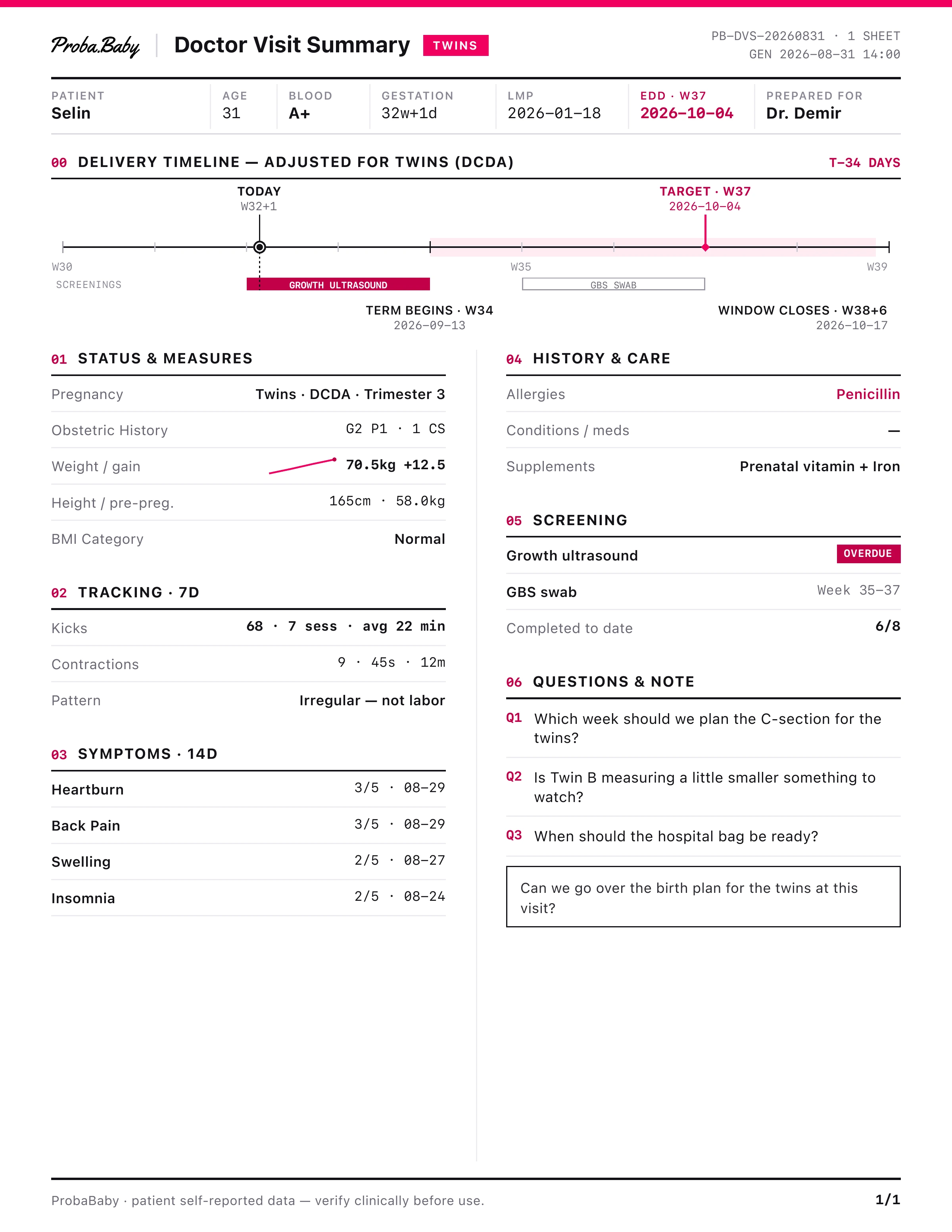
Sample Doctor Visit Summary for a twin pregnancy at week 32: delivery timeline adjusted for twins, weight, kicks, contractions, symptoms, screenings and your questions on one sheet. Fictional patient.
Frequently asked questions
It depends on your pre-pregnancy BMI. The IOM 2009 guidelines recommend 12.5–18.0 kg total if your BMI is under 18.5, 11.5–16.0 kg for BMI 18.5 to under 25, 7.0–11.5 kg for BMI 25 to under 30, and 5.0–9.0 kg for BMI 30 and above. These are singleton ranges — twin pregnancies have higher targets.
Twin totals are substantially higher: 16.8–24.5 kg for a BMI of 18.5 to under 25, 14.1–22.7 kg for BMI 25 to under 30, and 11.3–19.1 kg for BMI 30 and above. The IOM publishes no weekly rate for any twin row, so any weekly figure here is derived from the total rather than published. And there is no IOM twin range at all for the underweight class (BMI under 18.5) — the calculator shows none there instead of inventing one.
Very little. First-trimester gain is usually small. This calculator models it as a band across the first 12 weeks — 1.2–1.8 kg for one baby, 1.8–2.7 kg for twins — with the steady weekly rate only starting after week 12.
The four standard bands from the IOM guidelines, based on your pre-pregnancy BMI: under 18.5 (underweight), 18.5 to under 25 (normal), 25 to under 30 (overweight), and 30 or above (obese). BMI is calculated as weight in kilograms divided by height in meters squared.
The total and weekly ranges come from the Institute of Medicine's 2009 report 'Weight Gain During Pregnancy: Reexamining the Guidelines', which ACOG endorses in Committee Opinion No. 548. They are population-level guidelines, not individual prescriptions — consult your healthcare provider for personalized guidance.
Yes — toggle the weight unit to lbs and both the input slider and all results switch to pounds. Under the hood all math runs in kilograms: pounds are converted in with the exact factor 1 lb = 0.45359237 kg, and results are converted out at 1 kg = 2.20462 lbs for display.