Pregnancy Water Intake Calculator
Your daily hydration goal from your weight, your activity level and whether you're carrying twins — floored at the IOM's pregnancy minimum and capped for safety.
The tool
Want this in your pocket? Get the iOS app:


How this works
Proper hydration supports amniotic fluid, nutrient delivery to your baby, and helps prevent common pregnancy issues like constipation and urinary infections. This calculator turns that need into a concrete daily number built from three things you already know: your weight, how active you are, and whether you are carrying twins.
Set your weight on the slider — in kilograms or pounds, whichever you prefer. The baseline is 30 ml of water for every kilogram of body weight, rounded to the nearest millilitre, so a heavier body starts from a higher target. If you enter pounds, we convert with the exact factor (1 lb = 0.45359237 kg) before doing any math.
Pregnancy adds one flat +300 ml on top of the baseline, and it is the same in every trimester — the IOM and EFSA each publish a single pregnancy increment, and neither publishes a trimester ladder. Your week changes the note you get, never the number. Movement does change it: nothing extra if you are mostly sedentary, +500 ml for moderate activity, and +1,000 ml for an active lifestyle.
The target never drops below the recommended pregnancy minimum — 2,300 ml a day for one baby, 2,500 ml for twins — and never rises above the 4,000 ml caution ceiling. The result updates instantly as you move the controls, and you pick its unit separately from your weight unit: millilitres or US fluid ounces, whichever you actually think in. One cup count sits underneath, sized to that unit, and a breakdown card shows exactly where your total came from.
The math behind it
The full formula is: raw target (ml) = round(weight in kg × 30) + 300 + activity bonus. That raw number is then floored at the recommended pregnancy minimum and capped at the caution ceiling, and the result is a whole millilitre.
The pregnancy increment is a flat +300 ml — the same in every trimester, because that is what the IOM and EFSA publish. Trimesters split at weeks 1–12, 13–27 and 28–40, the same boundaries our pregnancy weight gain calculator uses, and your trimester changes the note you get rather than the number.
The activity bonus is +0 ml if you are sedentary (mostly sitting, light movement), +500 ml for moderate activity (regular walking, light exercise), and +1,000 ml if you are active (daily exercise, active lifestyle).
The target never drops below the recommended pregnancy minimum: 2,300 ml a day for one baby (the IOM's beverage figure), 2,500 ml for twins (Alberta Health Services' guideline for multiples points to the singleton figure as a minimum). Unit conversions use exact constants: 1 lb = 0.45359237 kg for the engine math, and 1 US fl oz = 29.5735 ml. There is one cup count, not two: cups a day = max(1, round(target ÷ cup size)), where a cup is 250 ml in millilitre mode and 8 fl oz in ounce mode.
Worked example: at 65 kg with moderate activity the baseline is 65 × 30 = 1,950 ml; the flat +300 ml pregnancy increment and the +500 ml activity bonus give 2,750 ml a day — 11 cups of 250 ml. The target is capped at 4,000 ml, so 150 kg and active returns 4,000 ml, not 6,000. More is not better: the weight rule overestimates at higher body weights, and very high intakes can dilute your blood sodium, which pregnancy already makes easier. Talk to your provider before aiming higher.
In the ProbaBaby app
iPhone · iPad · Apple WatchYour water target now, and hydration logging after the birth
The app has this calculator in its Pregnancy Health tools. After your baby arrives, the Mom Recovery hub logs how much you drink alongside the rest of your recovery.
The app also
- The same water calculator in the app, with a daily floor and a ceiling rather than one number.
- After the birth, the Mom Recovery hub logs hydration next to sleep, mood, nourishment, pumping and medication.
- A “Log Hydration” Siri shortcut, so a glass can be logged hands-free.
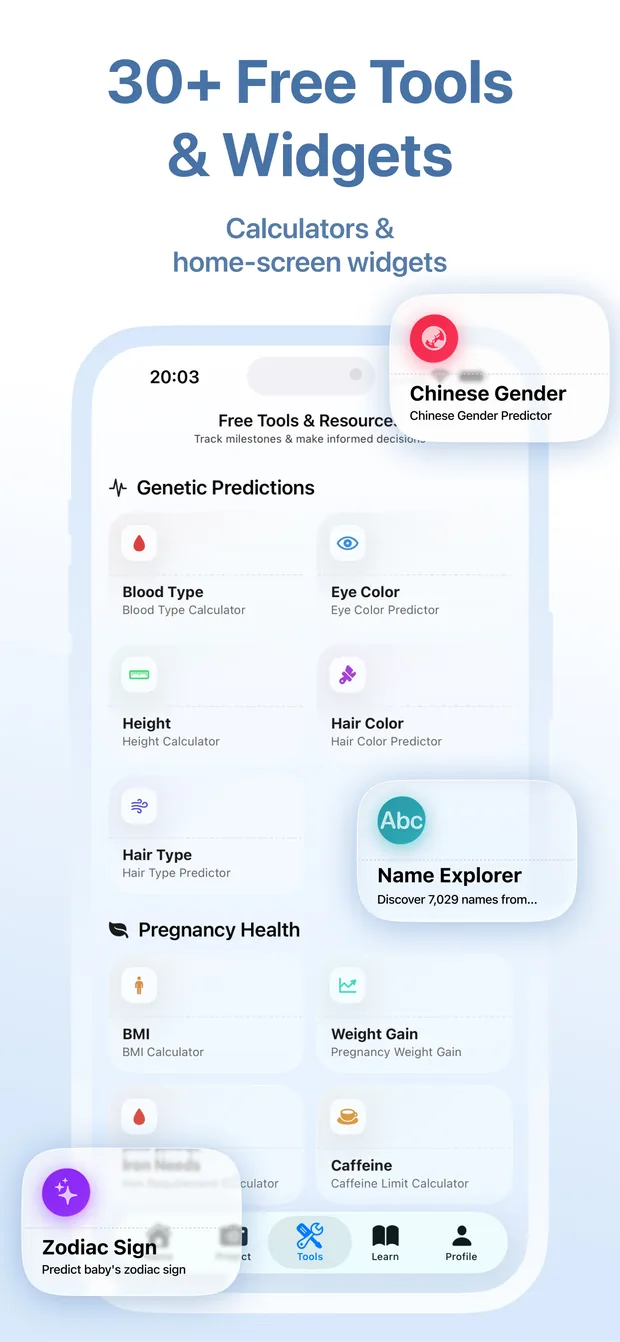
- Caffeine, iron, BMI and weight-gain calculators in the same group, among 32 free tools.
Free to download and use: pregnancy, baby and mom tracking, 32 tools, PDF reports, widgets, Apple Watch and family sharing cost nothing. Only AI baby predictions use credits.
On the App Store
Frequently asked questions
This calculator's guideline starts at 30 ml per kilogram of body weight, adds a flat 300 ml for pregnancy and 0–1,000 ml for your activity level, then floors the result at 2,300 ml (2,500 ml for twins) and caps it at 4,000 ml. At 65 kg with moderate activity that works out to 2,750 ml a day — 11 cups of 250 ml. This is a general guideline; consult your healthcare provider for personalized hydration advice.
No. Pregnancy adds one flat +300 ml, the same in every trimester — the IOM and EFSA each publish a single increment and neither publishes a trimester ladder. Your trimester changes the note the calculator shows you, never the number. The old +300/+400/+500 ramp was removed from the app because no source publishes it.
Yes. A sedentary routine (mostly sitting, light movement) adds nothing to the baseline, moderate activity (regular walking, light exercise) adds 500 ml, and an active lifestyle (daily exercise) adds 1,000 ml per day.
Yes — toggle the weight unit to lbs and the slider converts in place (88–330 lbs). The engine converts pounds to kilograms with the exact factor 1 lb = 0.45359237 kg. The result's unit is a separate choice: switch it to US fluid ounces (1 oz = 29.5735 ml) whether you entered kg or lbs.
There is one cup count, sized to the unit you picked: 250 ml in millilitre mode and 8 US fl oz in ounce mode. It is rounded, not rounded up, and never drops below 1 — cups = max(1, round(target ÷ cup size)).
No. This is a general guideline. Consult your healthcare provider for personalized hydration advice — especially if you have a condition that affects how much fluid you should drink.