Baby Eye Color Predictor
Pick each parent's eye color and see the odds for your baby's, with the Punnett squares behind them.
The tool
Want this in your pocket? Get the iOS app:


Every parent pairing
The model's chances for every pair of parent eye colors, with no grandparent information (each parent's hidden genes at even odds). Colors in the same group give the same result, because two genes cannot tell them apart.
| Parents | Chance of each color group |
|---|---|
| Brown + Brown | Brown or amber 79%, Blue or gray 11%, Hazel or green 10% |
| Brown + Amber | Brown or amber 79%, Blue or gray 11%, Hazel or green 10% |
| Brown + Hazel | Brown or amber 59%, Hazel or green 30%, Blue or gray 11% |
| Brown + Green | Brown or amber 59%, Hazel or green 30%, Blue or gray 11% |
| Brown + Gray | Brown or amber 56%, Blue or gray 33%, Hazel or green 11% |
| Brown + Blue | Brown or amber 56%, Blue or gray 33%, Hazel or green 11% |
| Amber + Amber | Brown or amber 79%, Blue or gray 11%, Hazel or green 10% |
| Amber + Hazel | Brown or amber 59%, Hazel or green 30%, Blue or gray 11% |
| Amber + Green | Brown or amber 59%, Hazel or green 30%, Blue or gray 11% |
| Amber + Gray | Brown or amber 56%, Blue or gray 33%, Hazel or green 11% |
| Amber + Blue | Brown or amber 56%, Blue or gray 33%, Hazel or green 11% |
| Hazel + Hazel | Hazel or green 89%, Blue or gray 11% |
| Hazel + Green | Hazel or green 89%, Blue or gray 11% |
| Hazel + Gray | Brown or amber 33%, Hazel or green 33%, Blue or gray 33% |
| Hazel + Blue | Brown or amber 33%, Hazel or green 33%, Blue or gray 33% |
| Green + Green | Hazel or green 89%, Blue or gray 11% |
| Green + Gray | Brown or amber 33%, Hazel or green 33%, Blue or gray 33% |
| Green + Blue | Brown or amber 33%, Hazel or green 33%, Blue or gray 33% |
| Gray + Gray | Blue or gray 100% |
| Gray + Blue | Blue or gray 100% |
| Blue + Blue | Blue or gray 100% |
Which genes each eye color allows
The model reads each parent's eye color as a group and keeps every genotype that fits it, weighted 1 : 2 : 1 as the even-odds starting point says. Grandparents can shift these weights.
| Eye colors | HERC2 | OCA2 | What it means |
|---|---|---|---|
| Brown, Amber | BB (1 in 3) or Bb (2 in 3) | PP (1 in 3) or Pp (2 in 3) | Switch on and pigment working. Two times in three the parent carries a hidden b, and two times in three a hidden p. |
| Hazel, Green | BB (1 in 3) or Bb (2 in 3) | pp | Switch on, but no working pigment copy: less melanin, so hazel or green. |
| Blue, Gray | bb | PP (1 in 4), Pp (2 in 4) or pp (1 in 4) | Switch off, so OCA2 cannot show. The eye color gives no clue about it, so it keeps the starting odds. |
How this works
Pick each parent's eye color from brown, amber, hazel, green, gray or blue. If you know the grandparents' eye colors, open the optional section and add them. The result updates as you click, and the page address keeps your choices so you can send them to someone.
The tool uses a simplified two-gene model. HERC2 works like a switch: with two "off" copies (bb) the pigment gene is shut down and the eyes are blue or gray. OCA2 makes the pigment: with the switch on, at least one working copy (P) gives brown or amber eyes, and none (pp) gives hazel or green. Two genes cannot tell the shades inside each pair apart, so the result comes in three groups.
You can see a parent's eye color but not their genes. A brown-eyed parent may or may not carry a hidden "off" copy, so the tool does not guess. It keeps every set of genes that fits the eye color and weighs them, starting from even odds for each version of each gene. That makes a brown-eyed parent a hidden carrier two times in three. The grandparents' eye colors then shift those odds: a blue-eyed grandparent makes the parent a certain carrier, and brown-eyed grandparents make it less likely.
Real eye color depends on dozens of genes, so treat the percentages as a way to see how inheritance works, not as a forecast. The result is an entertainment estimate, not genetic testing or medical advice.
The math behind it
The starting point (the prior). Before anyone's eye color is known, the two versions of each gene are taken as equally common, so a person is BB, Bb or bb in the ratio 1 : 2 : 1 (and PP, Pp or pp the same). This is a deliberately neutral choice: how common the hidden variants are differs between populations, and this page does not ask about ancestry.
Reading a parent's eye color. Brown or amber means HERC2 BB or Bb and OCA2 PP or Pp. Keeping the 1 : 2 : 1 weights, the parent is Bb with chance 2/3 and passes on B with chance 1/3 + 2/3 × 1/2 = 2/3; the same holds for P. Hazel or green means BB or Bb with pp (passes B with chance 2/3, never P). Blue or gray means bb (never passes B); OCA2 is hidden behind the switch, so it keeps 1 : 2 : 1 and passes P with chance 1/2.
The baby. For each gene the tool builds a weighted Punnett square: each parent's two alleles are weighted by the chance that parent passes them on. The baby is blue or gray when both parents pass b; hazel or green when the switch is on but both pass p; brown or amber otherwise. For a brown-eyed and a blue-eyed parent: blue or gray = 1/3 × 1 = 1/3; both pass p = 1/3 × 1/2 = 1/6; so brown or amber = 2/3 × 5/6 = 5/9 (56%) and hazel or green = 2/3 × 1/6 = 1/9 (11%).
Grandparents (updating the odds). A grandparent's eye color limits their own genes the same way, and an unknown grandparent keeps the 1 : 2 : 1 start. Crossing the two grandparents gives the parent's possible genes; the parent's own eye color then rules some out, and the rest are rescaled to add up to 1. Two brown-eyed parents who each have a blue-eyed parent are both certain carriers (Bb), so their baby is blue or gray with chance 1/2 × 1/2 = 1/4: the classic one in four. If the grandparents' colors cannot produce the parent's color in this model, the tool leaves them out and says so.
Percentages are rounded to whole numbers, so a list can add up to 99 or 101. The tool shows 100% only when the model leaves no other outcome, which happens only when both parents have blue or gray eyes. The checks behind this page compare the code with eight hand-worked examples and confirm that no other pairing, with any grandparents, reaches 100%.
In the ProbaBaby app
iPhone · iPad · Apple WatchThe app's prediction uses more of your family, and covers more than eye colour
This page is a teaching model: two genes, three colour groups and even odds for every hidden variant. The prediction in the ProbaBaby app starts from the same two genes, adjusts the odds for the ancestry you enter, gives each eye colour its own odds and adds hair, skin tone, height and facial features. Premium also asks about the grandparents and your family history.
The app also
- Each eye colour on its own line (brown, amber, hazel, green, gray and blue) instead of three groups, plus hair colour with MC1R red hair, hair type and a three-gene skin-tone range.
- Premium asks about the people behind each parent: 4 grandparents' eye and hair colour, and the family history of recessive traits on each side. Those are the clues that show whether a brown-eyed parent carries a light-eye variant.
- A confidence score that starts at 60% and rises as you add family information, up to 95%. It measures how complete your inputs are, not accuracy.
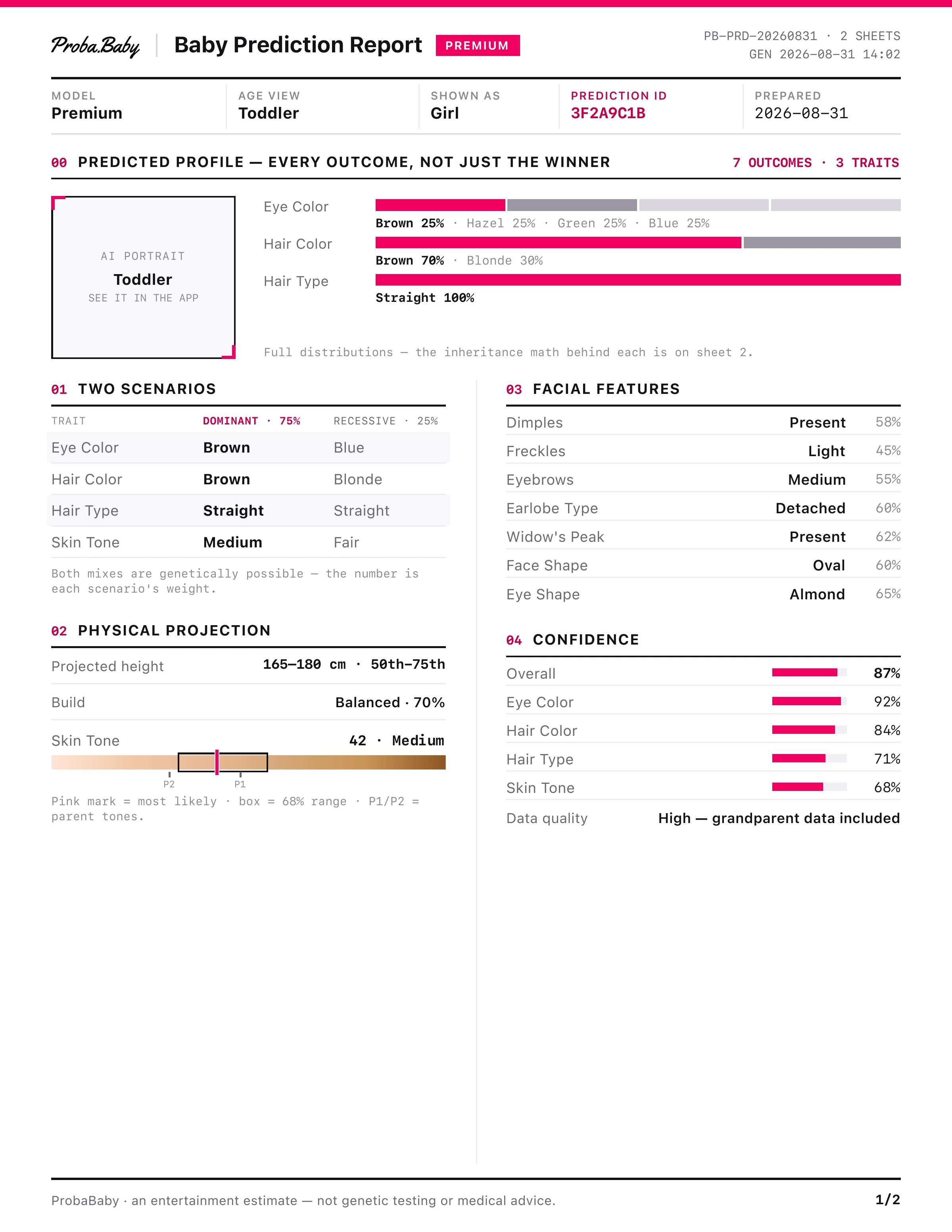
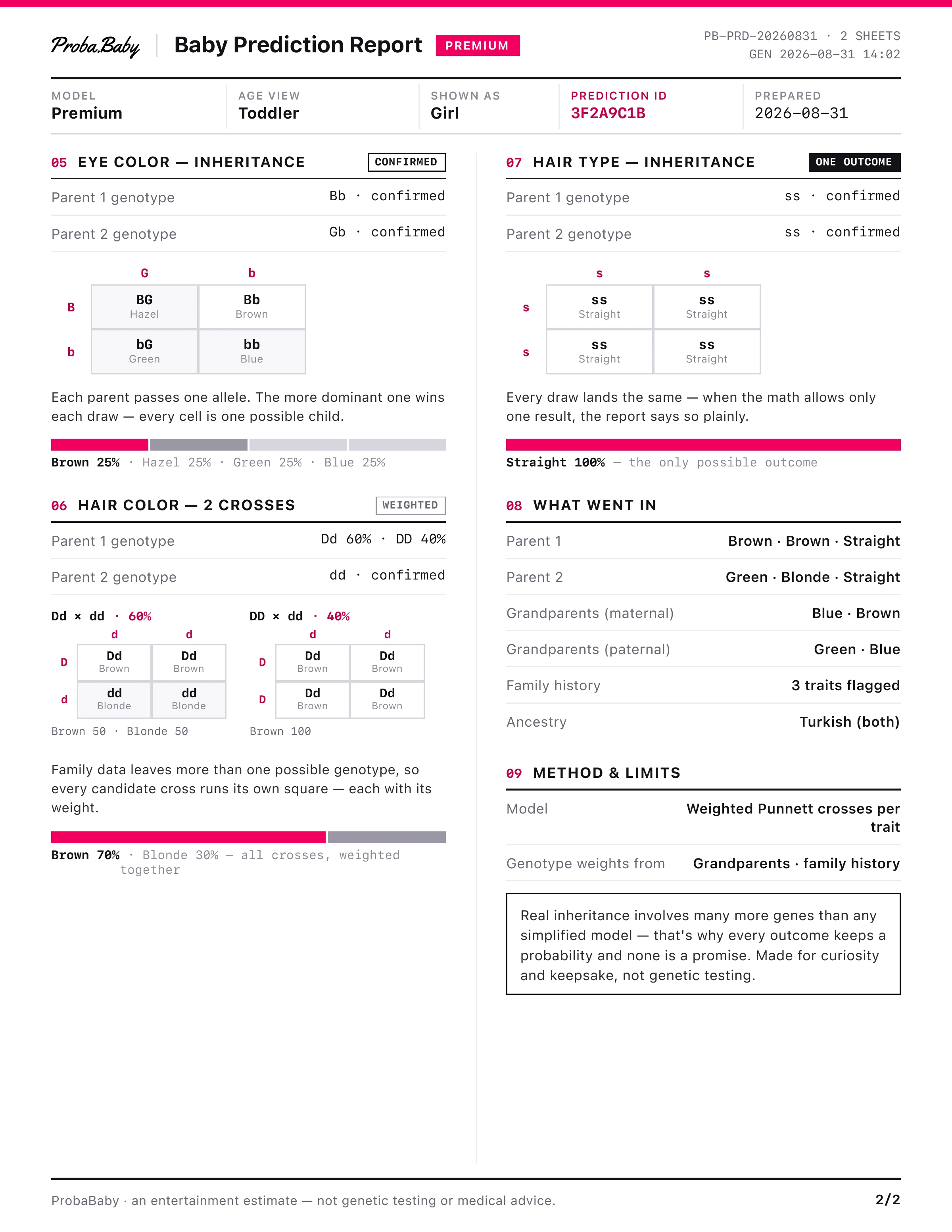
- A 2-sheet PDF report: every outcome for every trait on the first sheet; one Punnett square per possible parent cross, what went in and the method's limits on the second.
- Standard and Premium add a photo or TrueDepth face scan of each parent and create 2 baby images, a dominant-traits and a recessive-traits version. Premium adds a video at no extra credits.
Every new account gets 5 starter credits — enough for one free Scientific prediction (4 credits).
On the App Store
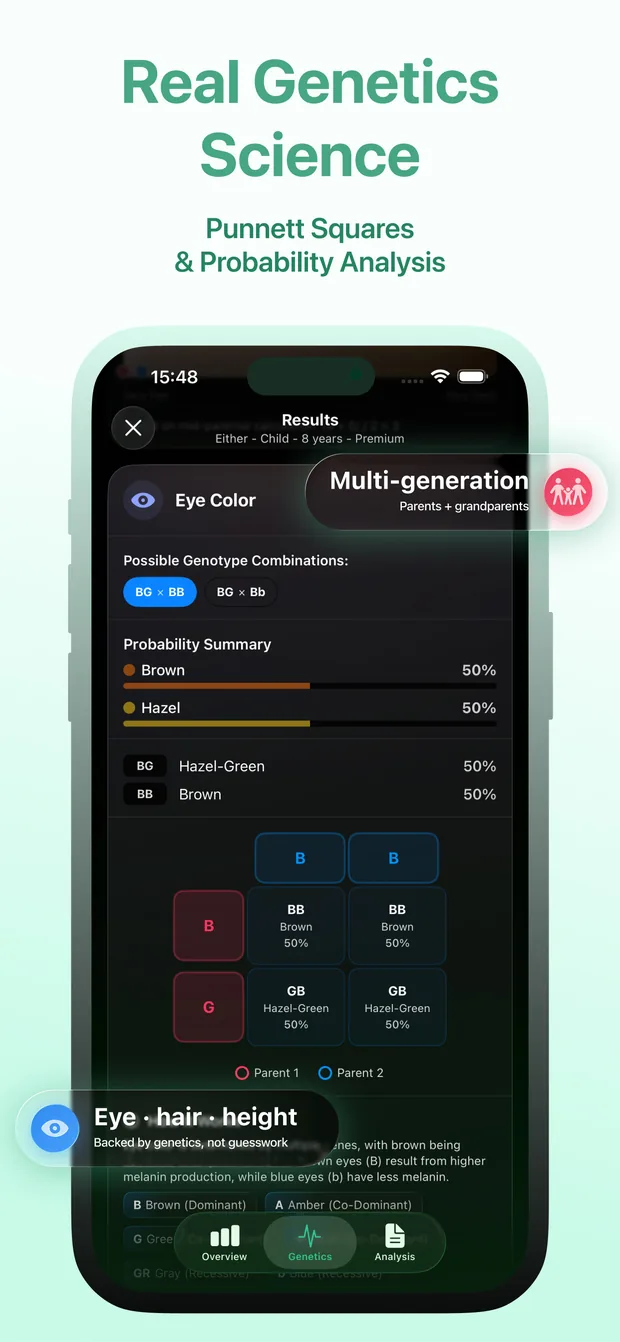
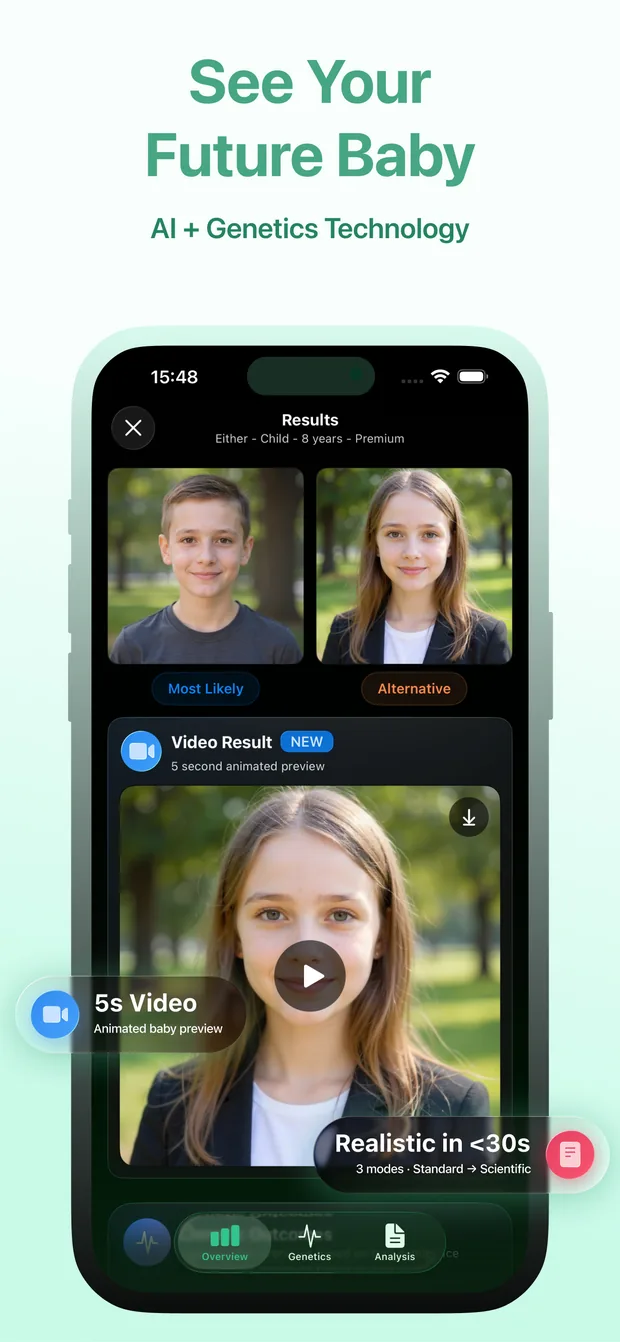
This page and the app, side by side
| Feature | This page | Scientific | Standard | Premium |
|---|---|---|---|---|
| Cost | Free, in your browser | 4 credits; starter credits cover your first | 8 credits | 12 credits |
| You describe | Each parent's eye colour; grandparents optional | Both parents' eye colour and shape, hair, face shape, physical traits, features and ancestry. No photos. | A photo or TrueDepth scan of each parent, plus eye colour and shape, hair, face shape, features and ancestry | Everything in Standard, plus physical traits, 4 grandparents' eye and hair colour and each side's family history |
| Starting odds | Even odds for every hidden variant | Adjusted for the ancestry you enter | Adjusted for the ancestry you enter | Adjusted for ancestry; grandparents and family history show who carries what |
| Eye colour | 3 colour groups | All 6 colours, each with its own odds | All 6 colours, each with its own odds | All 6 colours, each with its own odds |
| Other traits | — | Hair colour and type, skin tone, height range, facial features | Hair colour and type, skin tone, height range, facial features | Hair colour and type, skin tone, height range, facial features |
| Baby images | — | None (no photos are used) | 2: dominant and recessive | 2: dominant and recessive, plus a video |
| Report | On this page | 2-sheet PDF and a written report | 2-sheet PDF and a written report | 2-sheet PDF and a written report |
| Confidence score | — | From 60% | From 60%, higher with both photos | Up to 95% with all 4 grandparents |
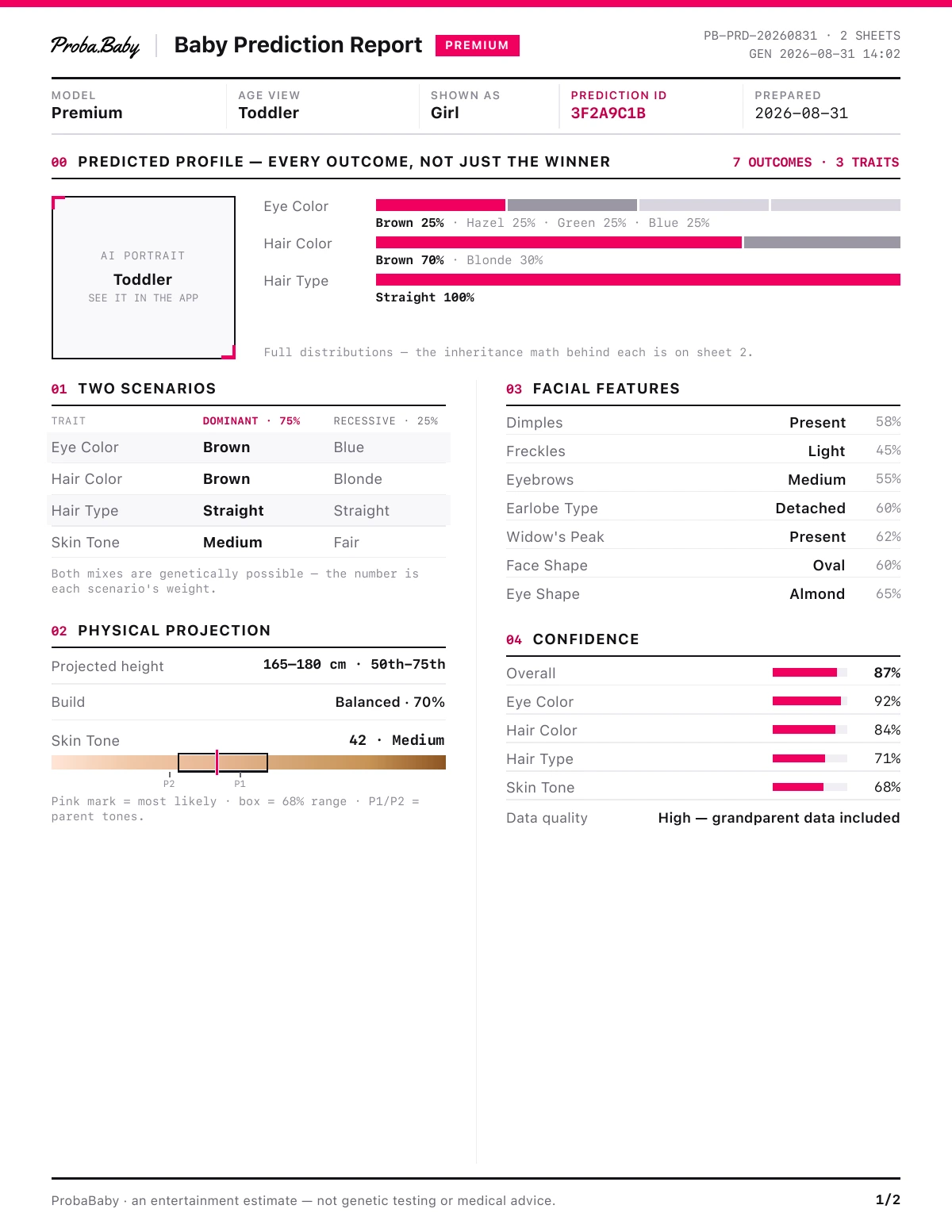
Sheet 1 of 2
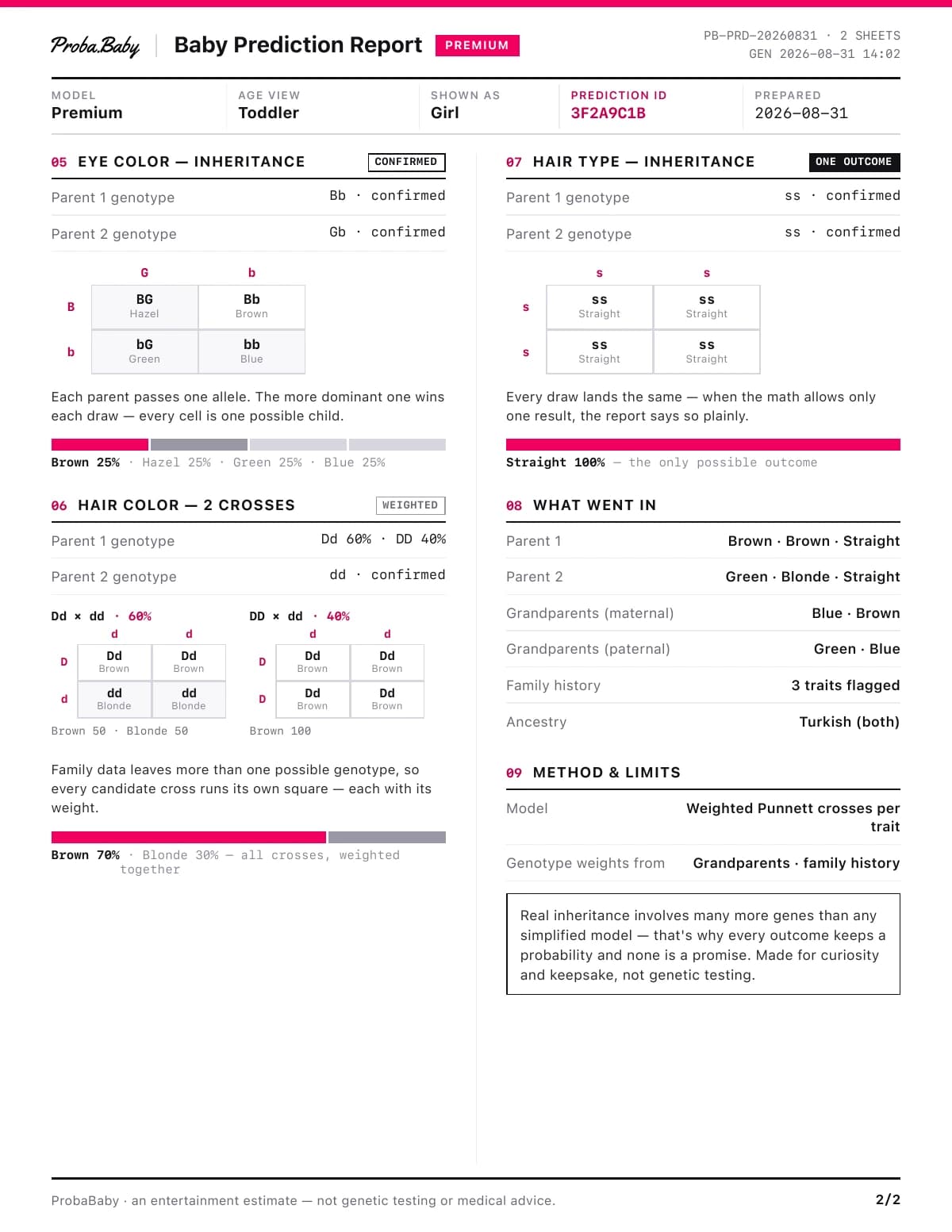
Sheet 2 of 2
Frequently asked questions
Yes, if both carry a hidden light-eye variant. With no family information the tool counts each brown-eyed parent as a carrier two times in three, which gives an 11% chance of blue or gray eyes. If a blue- or gray-eyed grandparent on each side shows that both parents are carriers, the chance becomes 25%, the classic one in four.
The tool shows 56% brown or amber, 11% hazel or green and 33% blue or gray. The blue-eyed parent always passes on the switch-off copy of HERC2, so the baby has light eyes only if the brown-eyed parent passes one on too. Brown-eyed grandparents on that side lower the light-eye chance; a blue-eyed grandparent raises it to 50%.
Two genes are not enough to separate brown from amber, hazel from green, or blue from gray: those shades depend on other genes and on the structure of the iris. Rather than invent numbers, the tool reports the group and leaves the exact shade open.
It has to start somewhere. How common the hidden variants are differs a lot between populations, and the page does not ask about ancestry, so it assumes the two versions of each gene are equally common. That is the neutral textbook starting point, and adding grandparents is the way to fit it to your family.
It is a guide, not a forecast. Large studies find that eye color involves more than 60 regions of the genome, while this tool uses two genes. A newborn's eyes can also change color during the first years.
OCA2 and HERC2, next to each other on chromosome 15, account for most of the difference between blue and brown. HERC2 contains a regulatory switch that controls how active OCA2 is, and OCA2 helps make the iris pigment melanin. Several other genes fine-tune the shade.
Yes. They are clues to what each parent carries. A blue- or gray-eyed grandparent shows that a brown-eyed parent carries the switch-off copy; two brown-eyed grandparents make that less likely. The tool updates each parent's odds with these clues, as the math section below sets out.
The color at birth is often not the final one. Many babies begin with gray or blue-gray eyes and their color can shift as the iris makes more melanin over the first months and years. The tool predicts the inherited tendency, not the color on day one.
Yes, the genetic model is the same. The ProbaBaby app's prediction uses this page's two-gene model: it keeps every HERC2 and OCA2 combination a parent could carry and weighs each one, instead of guessing a single one. On top of that, the app adjusts the odds for the ancestry you enter, gives each of 6 eye colors its own odds and adds hair, skin tone, height and facial features. Premium also asks for 4 grandparents' eye and hair color and each side's family history.
Related tools
Related tools