Period Calculator
Your next period is due one cycle length after the last one began. See your next three periods and your ovulation day.
The tool
Want this in your pocket? Get the iOS app:


What a typical cycle looks like
Day 1 of a cycle is the first day of bleeding, and the cycle ends the day before the next period. These are the limits doctors use to call a cycle typical. Being outside one is a reason to talk to your doctor, not a diagnosis.
| Measure | Typical | Source |
|---|---|---|
| Cycle length (first day to first day) | 24 to 38 days | FIGO 2018 |
| Irregular, by the NHS definition | Shorter than 21 days or longer than 35 days | NHS |
| Change from cycle to cycle | Up to 7 days between your shortest and longest cycle (up to 9 days at ages 18 to 25 and 42 to 45) | FIGO 2018 |
| Period length | Usually 2 to 7 days; more than 8 days counts as prolonged | NHS · FIGO 2018 |
| Blood lost in one period | About 20 to 90 ml, roughly 1 to 5 tablespoons | NHS |
| Bleeding between periods | Not expected: worth a doctor's visit | FIGO 2018 · NHS |
A worked example
If your last period started on March 1, 2026 and your cycle is 28 days, your next periods are due on March 29, 2026, April 26, 2026 and May 24, 2026. Ovulation in that cycle would be around March 14, 2026, about 14 days before the next period.
How this works
The short answer: add your cycle length to the first day of your last period. If your last period started on 1 March and your cycle is 28 days, your next period is due on 29 March. The calculator does this for the next three periods and shows how long each one should last.
Enter the first day of your last period, your usual cycle length (the days from the first day of one period to the first day of the next) and how many days you usually bleed. You also see this cycle's estimated ovulation day and fertile window. If the expected day has passed, the page says so and points you to the right test day. You can print the forecast or save it as a PDF, and copy a link that brings the same dates back.
Periods are rarely exact. A few days early or late is common, and stress, illness, travel, weight change and breastfeeding can all move them. FIGO counts cycles of 24 to 38 days as typical; the NHS calls cycles shorter than 21 days or longer than 35 days irregular. These are calendar estimates: they are not contraception and not a diagnosis.
The math behind it
Next period = first day of your last period + cycle length. The two after it are one more cycle length each. Each period is shown as lasting the number of days you entered. This is the rule of the ProbaBaby app's Planning engine, and the calculator is tested against the app's own functions on every cycle length from 20 to 45 days.
Ovulation for the same cycle = cycle length − 14 cycle days (an average 14-day luteal phase), and the fertile window is the five days before it plus the day itself (Wilcox 1995). Below 21 days the estimate is marked as unreliable; outside FIGO's 24 to 38 days the cycle is marked as atypical.
A period counts as late here once the expected first day has passed. That is a calendar fact only: it does not say why a period is late.
In the ProbaBaby app
iPhone · iPad · Apple WatchLog your periods and let your own history speak
This page works from one number you type in. In the app's free Planning module you log each period, and the calendar, charts and regularity check build on what you actually logged.
The app also
- Log each period with flow (light to very heavy), spotting, colour, clots and the products you used.
- A cycle calendar with your predicted periods, and a cycle-length chart among seven cycle charts.
- A regularity check on FIGO's age-banded rule that waits for at least three cycles before calling your cycle regular.
- After birth, an opt-in Period Tracking module: bleeding in the first 56 days is logged as lochia and never counted as a cycle, and fertile days stay hidden until your cycles settle.
PDF reports for the doctor visit, pediatrician visit, prediction, birth plan, birth decisions, cycle, fertility and the Period Tracker’s postnatal check, shareable by QR code (24 hours, one view). There is no CSV export from the baby log.
On the App Store
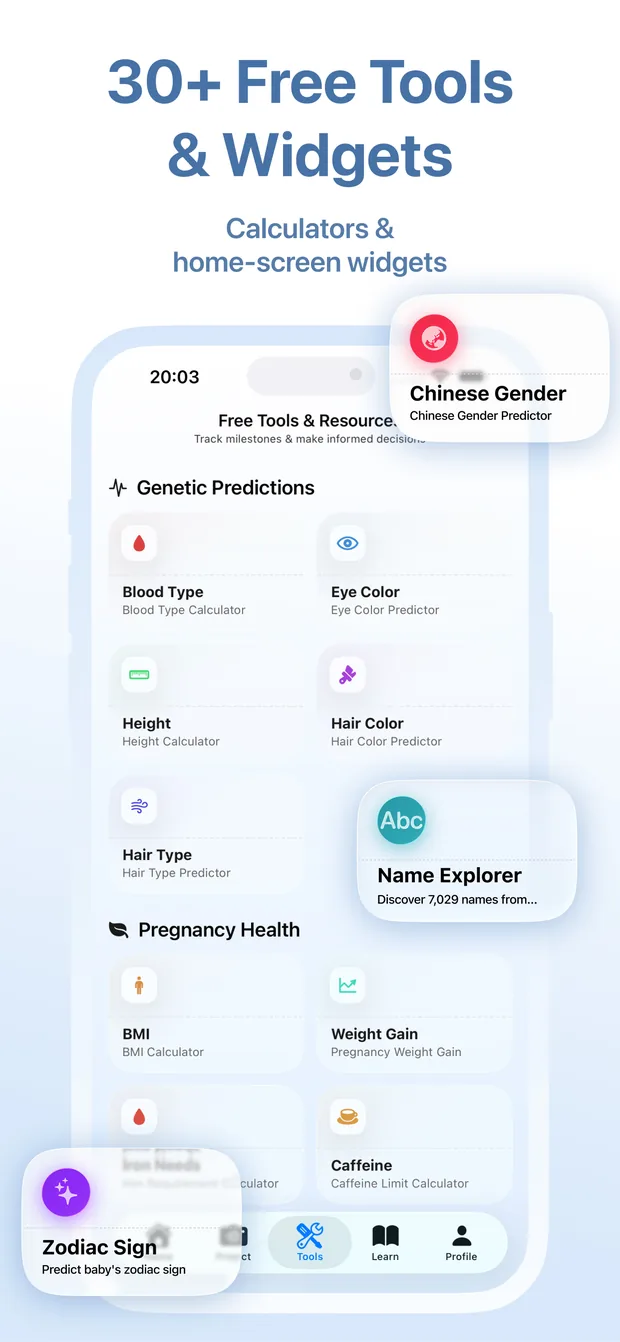
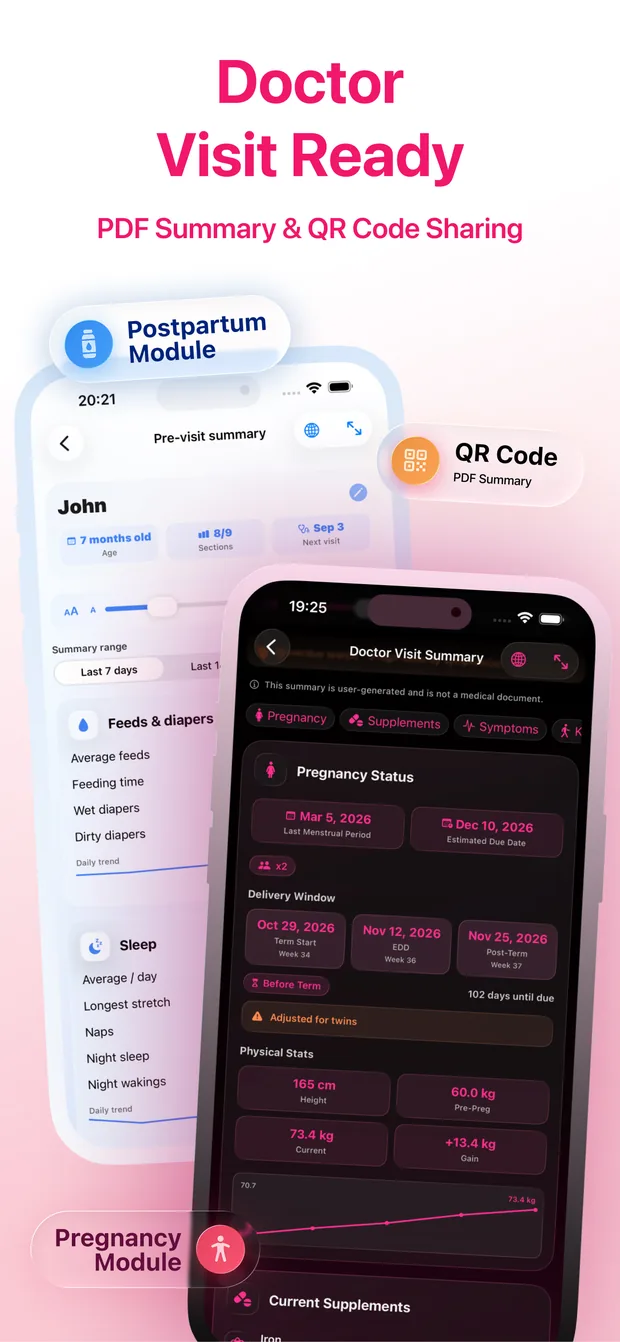
This page and the app, side by side
| Feature | This page | ProbaBaby app |
|---|---|---|
| Next period | From the cycle length you type in | From your settings, on a calendar with your logged periods |
| Your history | — | Every period with flow, colour and clots, plus a cycle-length chart |
| After birth | — | Period Tracking that keeps lochia out of your cycles |
Frequently asked questions
Add your cycle length to the first day of your last period. A 28-day cycle that started on 1 March gives 29 March; a 32-day cycle gives 2 April. Count your cycle from the first day of one period to the first day of the next, and use your average if it varies.
FIGO, the international federation of gynaecologists, counts 24 to 38 days as typical, and up to 7 to 9 days of difference between your shortest and longest cycle as regular. The NHS calls cycles shorter than 21 days or longer than 35 days irregular. Around 28 days is the average, not a target.
Usually 2 to 7 days, the NHS says, with about 20 to 90 ml of blood lost, roughly 1 to 5 tablespoons. FIGO counts bleeding for more than 8 days as prolonged. If your periods are very heavy or long, see your doctor: help is available.
Pregnancy is one possible reason, and a test can tell you. Most pregnancy tests work from the first day of a missed period (NHS). Stress, illness, weight change, exercise, breastfeeding and some contraception can also delay a period. If you have missed 3 periods in a row and are not pregnant, see your doctor.
No. A period calculator is not contraception. Ovulation moves from cycle to cycle, and sperm can survive for up to 7 days (NHS), so there is no day a calendar can promise is safe. Talk to your doctor, midwife or a sexual health service about contraception.
If you have missed 3 periods in a row and are not pregnant, your periods last more than 8 days, you bleed between periods or after sex, or your periods are suddenly much heavier or more painful. Very heavy bleeding, or bleeding with severe pain, dizziness or fainting, needs your emergency number straight away.
Related tools
Related tools