Wake Window Calculator & Baby Sleep Schedule
How long your baby can stay awake, how many naps to expect, and a sample day built from your baby's wake-up time.
The tool
Want this in your pocket? Get the iOS app:


Wake windows and naps by age, newborn to 18 months+
The nine age bands the ProbaBaby app uses, side by side. Find your baby's age in the first column and read across. Ages are from birth; for a baby born early, ask your paediatrician whether to read them by corrected age.
| Age | Wake window | Naps | Total sleep | Night | Day | Nap length |
|---|---|---|---|---|---|---|
| 0–4 weeks | 45–60 min | 4–6 | 14–17 h | 8–9 h | 6–8 h | 30 min – 2 h |
| 1–2 months | 1 h – 1 h 30 min | 4–5 | 14–17 h | 8–10 h | 6–7 h | 30 min – 2 h |
| 2–3 months | 1 h 15 min – 1 h 45 min | 3–5 | 14–16 h | 9–10 h | 5–6 h | 45 min – 2 h |
| 3–4 months | 1 h 30 min – 2 h | 3–4 | 13.5–15.5 h | 10–11 h | 3.5–4.5 h | 45 min – 2 h |
| 4–6 months | 2 h – 2 h 30 min | 3 | 13–15 h | 10–11 h | 3–4 h | 45 min – 2 h |
| 6–9 months | 2 h 30 min – 3 h | 2–3 | 12.5–15 h | 10–11.5 h | 2.5–3.5 h | 1 h – 2 h |
| 9–12 months | 3 h – 4 h | 2 | 12.5–15 h | 10.5–12 h | 2–3 h | 1 h – 2 h |
| 12–18 months | 4 h – 5 h | 1–2 | 11–14 h | 10–11.5 h | 1.5–2.5 h | 1 h – 2 h 30 min |
| 18+ months | 5 h – 6 h | 1 | 11–14 h | 10–11.5 h | 1.5–2.5 h | 1 h 30 min – 3 h |
A sample day from a 07:00 wake-up
The same arithmetic the calculator uses, run for every band: one wake window before each nap and before bed, naps of equal length. Under 2 months it is a picture of the rhythm, not a timetable.
| Age | Naps | Bedtime |
|---|---|---|
| 0–4 weeks | 07:50–09:15 · 10:05–11:30 · 12:20–13:45 · 14:35–16:00 · 16:50–18:15 | 19:05 |
| 1–2 months | 08:15–09:35 · 10:50–12:10 · 13:25–14:45 · 16:00–17:20 · 18:35–19:55 | 21:10 |
| 2–3 months | 08:30–09:55 · 11:25–12:50 · 14:20–15:45 · 17:15–18:40 | 20:10 |
| 3–4 months | 08:45–09:45 · 11:30–12:30 · 14:15–15:15 · 17:00–18:00 | 19:45 |
| 4–6 months | 09:15–10:25 · 12:40–13:50 · 16:05–17:15 | 19:30 |
| 6–9 months | 09:30–10:30 · 13:00–14:00 · 16:30–17:30 | 20:00 |
| 9–12 months | 10:30–11:45 · 15:15–16:30 | 20:00 |
| 12–18 months | 12:00–14:00 | 19:00 |
| 18+ months | 12:30–14:30 | 20:00 |
Where these numbers come from
Total sleep: the bands stay within the World Health Organization's ranges — 14–17 hours a day from birth to 3 months, 12–16 hours from 4 to 11 months and 11–14 hours for one- and two-year-olds, naps included; the 3–4-month band (13.5–15.5 hours) falls at the changeover between the first two. From 12 months the app's bands give 11–14 hours, the same as WHO and the American Academy of Sleep Medicine; the last band, 18 months and over, keeps 11–14, while the AASM gives 10–13 hours from age three.
The American Academy of Sleep Medicine, whose recommendation the AAP endorsed, gives no figure under 4 months at all, because normal newborn sleep varies so widely.
Wake windows are a parenting convention. No guideline body publishes a wake-window table; the figures are arithmetic and observation layered on the sleep totals. Nap counts follow the averages in a 2012 review of 34 studies (Galland et al.), whose normal ranges are wide.
Cues beat the clock
- Early — the gaze drifts, movements slow, a favourite toy stops being interesting.
- Middle — yawning, rubbing eyes or ears, jerky arms, pink eyelids, fussing mid-feed. Aim for bed here.
- Late — arching, back-stiffening, crying that nothing settles. By now settling usually takes longer.
Too short and too long both end in short naps. A cheerful baby who takes a long time to fall asleep is probably under-tired; one who is frantic before you reach the cot is probably over-tired. Move by about 15 minutes and give it a few days before judging.
Talk to your paediatrician or health visitor if…
- your baby is unusually sleepy, hard to wake for feeds or floppy;
- your baby is feeding poorly, has fewer wet nappies than usual, or is not gaining weight;
- your baby snores, gasps or pauses in breathing during sleep;
- your baby is under 3 months and has a temperature of 38 °C or higher (call straight away);
- you are worried about your baby's sleep, or your own exhaustion feels unsafe.
Call your emergency number if your baby stops breathing, turns blue or grey, cannot be woken, or has a rash that does not fade under a pressed glass.
How this works
Enter your baby's birth date, or just an age in weeks or months. In Wake windows mode the calculator shows how long a baby of that age typically stays awake between sleeps, how many naps a day to expect, and how much sleep the whole day usually holds, split into night and day. Add the time your baby last woke up and it also shows when the next sleep is likely to be due — the moment to start watching for sleepy cues, not an alarm.
Switch to Sleep schedule mode and enter the time your baby usually starts the day. The calculator lays out a sample day: a wake window before each nap, naps of equal length, and a bedtime one more wake window after the last nap. A 5-month-old who wakes at 07:00, for example, gets naps at 09:15, 12:40 and 16:05 and a bedtime of 19:30.
The numbers are the nine age bands the ProbaBaby app's Sleep Schedule tool uses, from newborn to 18 months and over. For the first two bands — the first eight weeks — the page says plainly that the day is a rhythm, not a timetable: feeds come first and naps happen when your baby is ready. From two months the sample day starts to follow the clock.
Every number here is a range for healthy babies, not a target. Two thriving babies of the same age can be a nap apart, and your baby's cues — a distant gaze, yawning, rubbing eyes, fussing mid-feed — are a better guide than any table. Nothing you enter is uploaded; the inputs live in the page address, so you can bookmark a result or send it to whoever does the next shift.
The math behind it
Age. From a birth date the calculator counts whole days. From a typed age it uses weeks × 7, or months × 30.4375 rounded — WHO's average month — so “4 months” is day 122, the start of the 4–6 month band. The bands run, in days from birth: 0–27, 28–55, 56–90, 91–120, 121–181, 182–272, 273–364, 365–545 and 546 onwards, and a baby belongs to the first band whose last day has not passed.
Next sleep. The time your baby woke up plus the band's wake window, at both ends. At 4–6 months the window is 2 h to 2 h 30 min, so a baby who woke at 13:20 is due to sleep between 15:20 and 15:50.
Sample day. Nap length = the middle of the band's day-sleep range divided by the number of naps in the sample day, kept inside the band's nap-length range and rounded to 5 minutes. Each nap starts one wake window after the last sleep ended, and bedtime comes one wake window after the last nap. Worked example, 4–6 months: day sleep 3–4 h, middle 3.5 h = 210 min, over 3 naps = 70 min each; the window is 135 min. Woke 07:00 → nap 09:15–10:25 → nap 12:40–13:50 → nap 16:05–17:15 → bedtime 19:30.
Where the ranges come from. The bands' total sleep stays within the World Health Organization's ranges: 14–17 hours from birth to 3 months, 12–16 hours from 4 to 11 months and 11–14 hours for one- and two-year-olds, naps included; the 3–4-month band, at 13.5–15.5 hours, falls at the changeover between the first two. The American Academy of Sleep Medicine gives the same 11–14 hours at one and two years and 10–13 hours from age three, while the last band here, 18 months and over, keeps 11–14. The AASM gives no figure under 4 months at all, because normal newborn sleep varies so much.
Wake windows themselves are a convention. No guideline body publishes a wake-window table; the figures are arithmetic and observation laid over the sleep totals, and nap counts follow the averages of a 2012 review of 34 studies, whose normal ranges are wide. This is the same engine as the app, checked against the app's own output for both edges of all nine bands and for twelve sample days.
In the ProbaBaby app
iPhone · iPad · Apple WatchLog the naps, and see the wake window against your baby's own day
The app's Sleep Schedule tool uses the same nine age bands as this page. Log sleep in the baby module and the app reads your baby's real day back against them.
The app also
- Every sleep is filed as a nap or a night sleep, with an optional quality rating, the place and a note.
- The sleep prediction shows your baby's current wake window next to the recommended one for their age, with a confidence level and the number of logs behind it.
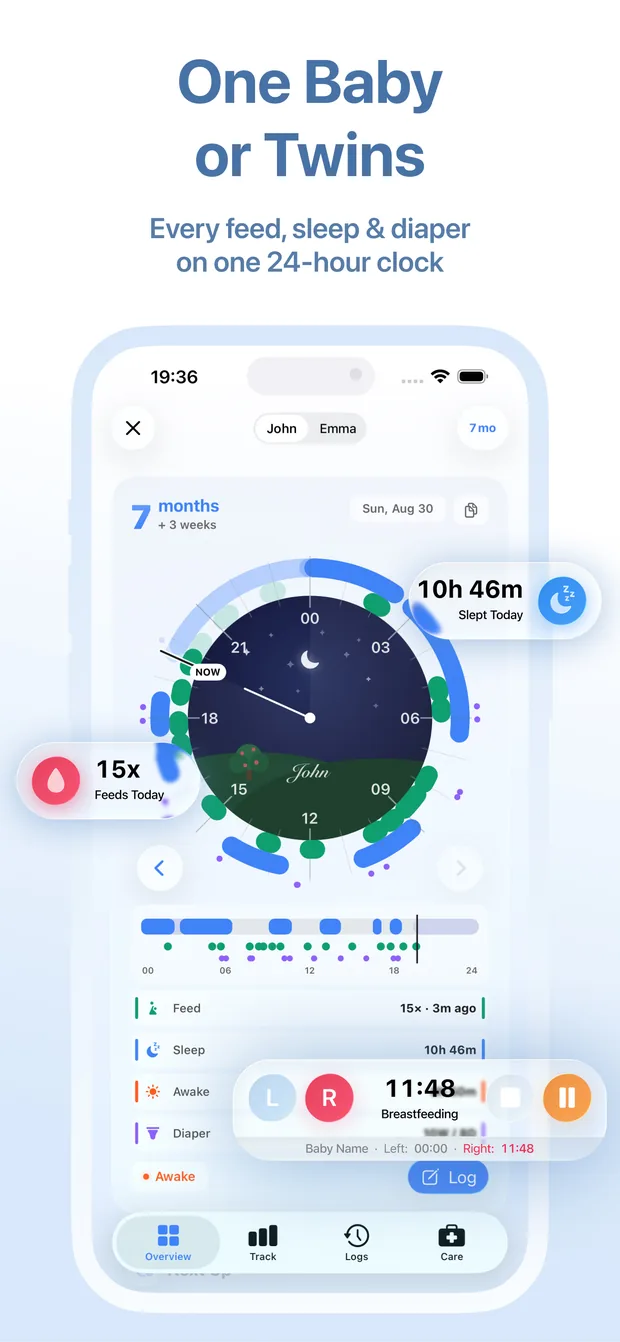
- A 24-hour day clock draws sleep and feeds as two rings and counts the day's feeds, sleep, awake time and diapers; awake time is worked out, never logged.
- Daily and weekly statistics keep the nap count, night sleep and night wakings, with per-day averages.
- Started logging late? Backdate a sleep by 5, 10 or 15 minutes, and follow a running sleep as a Live Activity on the Lock Screen.
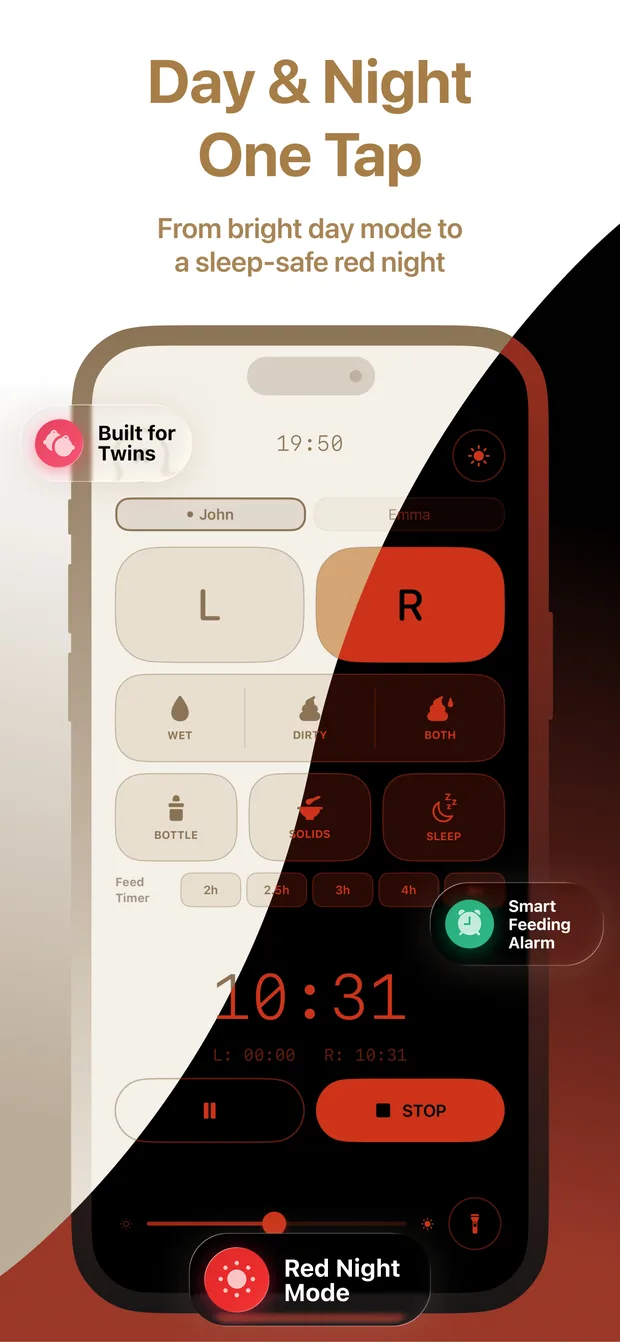
Baby: feeding (breast, bottle, pumped milk, formula and solids), sleep with pattern insights, diapers with stool colour, WHO growth percentiles, 58 milestones, a 24-hour day clock, a red-light night console, age-adaptive feeding reminders and an alarm that wakes you even on silent.
On the App Store
Frequently asked questions
A wake window is the time a baby is awake between the end of one sleep and the start of the next. It is a parenting convention rather than a clinical measurement — WHO, the AAP and the NHS publish total sleep per day, not wake-window tables — but it is a useful way to guess how much awake time a baby of a given age can manage before settling gets hard.
For the first four weeks this calculator uses 45 to 60 minutes, which is roughly one feed, a nappy change and a cuddle; other charts quote from about 35 minutes. Newborns sleep in short stretches around the clock, so treat the window as a ceiling to notice, not a schedule — feeding comes first in the early weeks.
As a guide: 4 to 6 short naps in the first month, 3 to 5 at 2–3 months, 3 at 4–6 months, 2 to 3 at 6–9 months, 2 at 9–12 months, 1 to 2 at 12–18 months and 1 from 18 months. The averages in research are lower and the normal ranges wide, so a baby who does well on one nap fewer is not doing anything wrong.
The bands move from 3 naps to 2 to 3 between 6 and 9 months, to 2 by 9–12 months, and to 1 or 2 between 12 and 18 months. The usual sign is a nap your baby fights for a week or more while the others stay fine. Because the window and the nap count are one sum, dropping a nap lengthens every wake window that day.
No. In the first two months the calculator deliberately shows a rhythm rather than a timetable: feeds come first, and your midwife or paediatrician may even ask you to wake a newborn to feed. The sample-day times start to mean something from about two months, when daytime and night-time sleep begin to separate.
Usually not. The ranges describe healthy babies and still miss many of them. If your baby feeds well, gains weight and settles, the table is wrong about your baby, not the other way round. Talk to your paediatrician or health visitor if your baby is unusually sleepy or hard to wake, feeds poorly, snores or pauses in breathing during sleep, or if you are worried for any reason.
Because sleep is reorganising. A 2012 review of infant sleep puts the emergence of the body clock at around 10 to 12 weeks, after which sleep becomes more and more nocturnal, and the AAP says babies do not have regular sleep cycles until about 4 months. Naps consolidate, nights lengthen, and in the bands here the window grows by more than an hour between 2 and 6 months — from 1 h 15 min–1 h 45 min to 2 h 30 min–3 h.
The bands count from birth. For a baby born early, ask your paediatrician whether to read them by corrected age — the age counted from the due date — which our corrected age calculator works out. Twins can share one sample day if that makes life easier, but each baby's cues still decide when that baby sleeps.
Related tools
Related tools